Trading Strategy
Search Space:
Why It Matters
A simple 7-component trading system can produce 600,000+ possible strategies. Most traders explore fewer than 200. The search space is the gap between what you test and what exists.
Table of Contents
What Is the Strategy Search Space?
The strategy search space refers to the total number of possible trading strategies that can be created from combinations of indicators, rules, parameters, order types, and capital allocation methods.
In algorithmic trading, a strategy is typically composed of multiple elements: entry signals, order execution methods, exit rules, risk management parameters, and position sizing logic. Each of these elements can take many possible values, creating an enormous number of potential strategy combinations.
Because of this complexity, discovering profitable strategies requires efficient methods for exploring the strategy search space. Automated research platforms such as Build Alpha are designed to search large portions of this space by generating and evaluating thousands of candidate strategies.
Key Concept
The search space is the gap between what you could test and what you actually test. Manual research covers a small fraction. Automated generation covers orders of magnitude more.
Components That Define the Search Space
Trading strategies are built from multiple components that define when trades occur, how they are executed, and how capital is allocated. Each component introduces new dimensions to the search space.
Even small changes in one component, such as using a different entry order type or position sizing method, can produce a completely different trading strategy. This is why the strategy search space grows exponentially as additional components and parameters are introduced.
Why the Search Space Is So Large
The search space is not additive. It is multiplicative. When you add a new component, you do not simply add more strategies to the total. You multiply the existing total by every possible value the new component can take.
This is the combinatorial explosion that makes trading strategy research fundamentally a search problem.
Position Sizing Alone Changes Everything
Position sizing is a component many traders overlook in their research. Different sizing methods can significantly affect both risk and overall performance. Common approaches include fixed contract or share size, fixed dollar allocation, fixed fractional sizing, and volatility-based position sizing.
Each sizing method applied to the same entry and exit logic produces a different strategy with different risk characteristics, drawdown profiles, and return distributions. And this is just one component out of many.
Order Types Add Another Dimension
Entry orders themselves differ depending on execution style. Market orders, limit orders, and stop orders each produce different fill prices, slippage characteristics, and trade frequency. Applying three order types across a strategy set triples the search space for that component alone.
Calculating Search Space Size
Even a relatively small set of strategy components can generate enormous numbers of possible strategies. Consider the following simplified example:
| Strategy Component | Possible Choices |
|---|---|
| Entry Indicator | 10 options |
| Entry Order Type | 3 options (market, limit, stop) |
| Exit Rule | 10 options |
| Stop Loss Level | 10 options |
| Profit Target | 10 options |
| Position Sizing | 4 options |
| Time Filter | 5 options |
In real research environments the number of indicators, filters, and parameters is often far larger. Expand across multiple markets and timeframes and the strategy search space can reach into millions or even billions of possible strategies.
Scale Perspective
If each backtest takes 1 second and you have 600,000 strategies to evaluate, exhaustive testing would take roughly 7 days of continuous computation, for a simplified example. Real search spaces are orders of magnitude larger.
Manual Research vs the Full Search Space
When traders design strategies manually, they typically test only a small number of ideas. A discretionary researcher might test a few indicators, a handful of parameter settings, and limited rule combinations.
This means manual research explores only a tiny portion of the overall strategy search space. As a result, many potential trading strategies remain undiscovered.
Manual Research
- Tests 50-200 strategy variations
- Limited to familiar indicators
- Biased toward popular approaches
- Explores < 0.1% of available space
- Constrained by researcher time
Automated Research
- Evaluates thousands to millions of combinations
- Searches all available indicators objectively
- No bias toward popular or intuitive rules
- Explores large regions of strategy space
- Scales with computational resources
This is the core difference between manual and automated trading research. Automated tools do not replace judgment. They expand the territory that judgment can evaluate.
Efficient Search Methods
Because the strategy search space is so large, testing every possible combination is usually impractical. Instead, automated research systems use methods designed to search promising regions of the space efficiently.
Genetic Algorithms
Evolve populations of strategies through selection, crossover, and mutation. Converge toward stronger candidates while maintaining diversity. Learn more →
Evolutionary Search
Broader family of population-based methods that iteratively improve candidate solutions through variation and selection pressure.
Heuristic Search
Rule-based approaches that prioritize promising regions based on domain knowledge, computational constraints, or prior results.
Randomized Generation
Generate large numbers of random strategy combinations and evaluate all of them. Simple but effective as a baseline and for benchmarking.
These techniques focus computational effort on regions of the strategy search space that show stronger performance. Over time, stronger strategy structures can emerge as weaker candidates are eliminated.
Search Space and Automated Strategy Generation
Automated strategy generation systems operate by exploring the strategy search space through a structured, iterative process.
This approach allows research platforms to explore large portions of the strategy search space efficiently. Tools like Build Alpha automate this exploration by generating and testing large numbers of strategies during a single research session.
The Overfitting Tradeoff
Exploring large search spaces increases the likelihood of finding strategies that appear profitable purely by chance.
This is the fundamental tradeoff of search space exploration: the more strategies you test, the more likely you are to find one that looks good on historical data by accident. Because of this, strategies discovered through automated search must undergo rigorous validation before deployment.
Sample
Forward
Carlo
Test
Benchmark
These tests help determine whether a strategy reflects genuine market structure rather than random historical patterns. The larger the search space explored, the more important validation becomes.
Critical Principle
Discovery without validation is curve fitting. The power to search large strategy spaces must always be paired with equally rigorous robustness testing. Without it, automated search produces nothing more than elaborate overfitting.
How Professionals Approach the Search Space
Professional systematic trading firms often treat strategy discovery as a search problem across extremely large rule spaces.
Rather than relying on a small number of manually designed strategies, many firms generate large libraries of candidate systems and continuously evaluate them for performance and stability.
Efficient exploration of the strategy search space is therefore a key component of modern systematic trading research. The firms that search more of the space, while maintaining validation discipline, tend to have deeper strategy libraries and better diversification.
Where Software Fits
The strategy search space is too large for manual exploration and too important to ignore. This is where automated research platforms become essential.
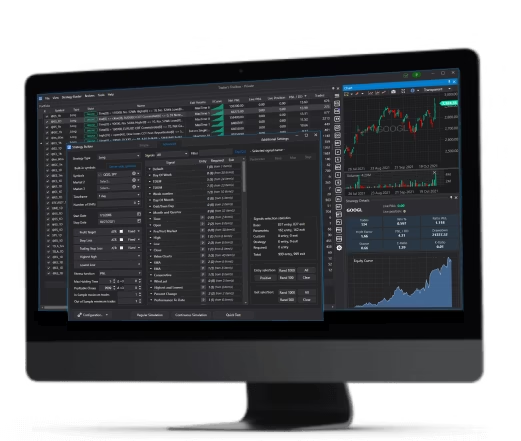
Build Alpha automates the full process: defining the search space through indicator and rule selection, generating thousands of candidate strategies, evaluating them using fitness functions, evolving stronger candidates through genetic algorithms, and applying comprehensive robustness testing.
This transforms strategy research from a manual, idea-driven process into a systematic search across the full strategy space. With built-in validation at every stage. Explore Build Alpha's strategy generator software or see examples of generated strategies.

David Bergstrom
David Bergstrom is the founder of Build Alpha, a no-code platform for automatically generated trading strategies. He has spent over a decade building systematic trading tools used by independent traders, proprietary firms, and hedge funds worldwide.
Frequently Asked Questions
What is the strategy search space in trading?
The strategy search space is the set of all possible trading strategies that can be created from combinations of indicators, order types, parameters, and risk management rules. Even simple systems can produce hundreds of thousands of combinations.
Why is the strategy search space so large?
Because trading strategies combine multiple components and parameters, the number of possible rule combinations grows exponentially, not linearly, as additional variables are added. A system with just 7 components can easily exceed 600,000 combinations.
Can traders manually search the strategy space?
Manual research can explore only a small portion of the strategy search space, typically fewer than 200 variations. Automated research tools allow traders to evaluate far more strategy combinations, covering regions that manual research cannot reach.
How do automated tools search the strategy space?
Automated systems generate candidate strategies, evaluate their performance using fitness functions, and evolve stronger candidates through iterative search methods such as genetic algorithms and evolutionary search.
Does searching a larger space increase overfitting risk?
Yes. The more strategies you evaluate, the more likely you are to find one that looks profitable by chance. This is why automated discovery must always be paired with rigorous robustness testing including out-of-sample validation, Monte Carlo simulation, and walk-forward analysis.
Final Thoughts
The strategy search space represents the enormous number of possible trading strategies that can be constructed from combinations of indicators, rules, execution methods, and position sizing approaches.
The question is not: "What strategy should I test?"
The question is: "How much of the search space am I actually exploring?"
Because this space grows exponentially as strategy complexity increases, manual research can explore only a small fraction of potential rule combinations. Automated strategy generation tools, whether traditional algorithms or AI-assisted methods, allow traders to search large portions of the strategy space more efficiently, increasing the chances of discovering robust trading strategies.
But discovery alone is not enough. Strategies found through automated search must still undergo rigorous validation to ensure that their performance reflects genuine market behavior rather than statistical noise. Understanding generation vs optimization is critical for navigating large search spaces effectively.
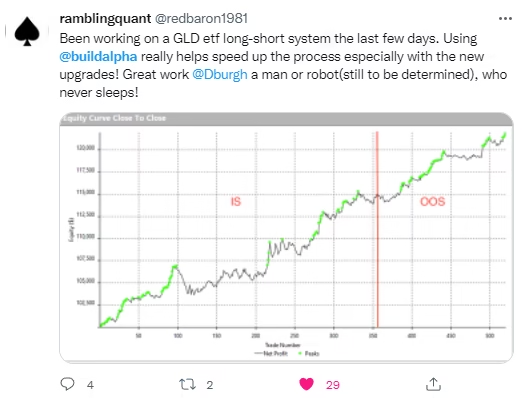
What Traders Say About Build Alpha
















600,000+ Strategies.
One Research Session.
Build Alpha explores the strategy search space at scale, generating, evaluating, and validating thousands of trading systems. No coding required.