Genetic Algorithms for
Trading Strategy Discovery
How do you efficiently search through millions of possible trading rule combinations? Genetic algorithms provide a structured, scalable answer, evolving strategies through selection, mutation, and crossover.
Table of Contents
- What Is a Genetic Algorithm?
- How GAs Apply to Trading
- Encoding Strategies as Chromosomes
- The Role of the Fitness Function
- Why GAs Are Effective
- The Risk: Overfitting at Scale
- Mutation and Crossover in Depth
- GAs vs Exhaustive Search
- GAs vs Machine Learning
- Combining GAs with AI
- Where GAs Fit in a Workflow
- Limitations
- Who Should Use GAs
- The Strategic Advantage
What Is a Genetic Algorithm?
A genetic algorithm (GA) is a population-based optimization method inspired by natural selection. Instead of optimizing a single candidate solution, a GA creates a population of candidates, evaluates each using a fitness function, selects stronger candidates, applies mutation and crossover, and repeats the process across generations.
Over time, weaker candidates are eliminated and stronger rule structures survive. In trading, those candidates are rule-based strategies. This process is selective breeding for trading strategies.
For traders seeking an automatic strategy generation process, genetic algorithms are among the most structured and proven methods available.

How Genetic Algorithms Apply to Trading Strategies
In strategy development, each candidate "organism" is a complete trading system. It may include market selection, entry conditions, exit rules, stop-loss logic, position sizing rules, parameter values, and risk management.
The GA evolves these components over multiple generations during a structured exploration of the strategy search space, producing automatically generated trading strategies.
Encoding Trading Strategies as "Chromosomes"
To apply a GA, strategies must be encoded in a structured format. Each component becomes a "gene", indicator type, lookback length, threshold values, logical operators, filter inclusion. A complete strategy becomes a "chromosome."
Mutation may change a lookback from 14 to 20, swap an RSI for a stochastic indicator, adjust a threshold, or add/remove a filter.
Crossover may combine entry logic from one strategy with exit logic from another. Over time, stronger combinations emerge, and more of the total search space is covered. But intelligently.
The Role of the Fitness Function in Genetic Algorithm Trading
A genetic algorithm does not "know" what a good strategy is. The fitness function defines the objective the algorithm seeks to optimize.
Common fitness metrics include net profit, Sharpe ratio, maximum drawdown, profit factor, stability metrics, and risk-adjusted return. The fitness function defines evolutionary pressure.
⚠ Fitness Design Matters
Poorly designed fitness criteria leads to fragile strategies. Well-designed fitness criteria reward stability, trade frequency, robustness, and risk control. A genetic algorithm will optimize whatever you tell it to optimize. If you reward unstable returns, it will find unstable returns.
Why Genetic Algorithms Are Effective for Strategy Discovery
They Scale
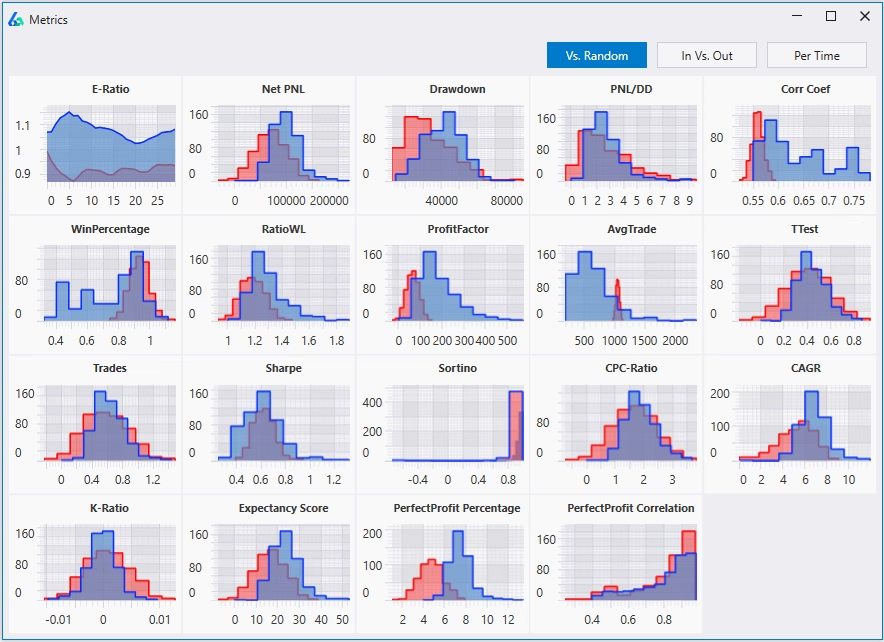
Manual design explores dozens of combinations. Genetic algorithms can explore thousands or millions, the entire combinatorial space becomes accessible.
They Reduce Bias
They do not prefer popular indicators or intuitive logic. They search based on defined performance criteria, data-driven decisions, not gut feelings.
They Encourage Diversity
Population-based optimization maintains multiple candidates simultaneously. This is ideal for portfolio construction.
They Adapt
As weaker strategies fail, stronger variations are promoted. This mimics structured learning, Darwinism applied to trading research.
The Risk: Overfitting at Scale
Genetic algorithms amplify both discovery and risk. Because they search extensively, they can find statistical artifacts, exploit noise, and over-optimize parameters.
Without proper validation frameworks, a GA will inevitably produce overfit systems. This is why genetic discovery must be paired with:
- Out-of-sample testing
- Walk-forward optimization
- Monte Carlo simulation
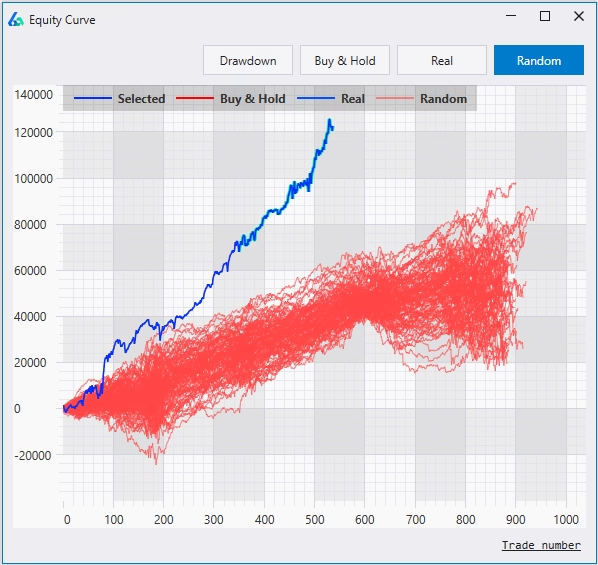
- Vs Random benchmarking
- Noise Testing
⚠ Critical
Discovery without validation is curve fitting. Read the full Robustness Testing Guide for detailed validation workflows.
Mutation and Crossover in Depth
Mutation introduces variation. Small parameter adjustments allow exploration of nearby regions in the search space.
Crossover allows recombination of successful traits. For example: Strategy A may have strong entries but weak exits. Strategy B may have weak entries but strong exits. Crossover may combine them into a stronger hybrid.
Too Much Mutation
Becomes random search. No convergence. Wastes computation.
Too Little Mutation
Stagnation. Gets trapped in local optima. Misses better regions.
These operators balance exploration (searching new areas) and exploitation (refining promising areas). Hyperparameter control matters.
Genetic Algorithms vs Exhaustive Search
Exhaustive search attempts to test every possible combination. This quickly becomes computationally infeasible.
Genetic algorithms do not attempt to test everything. They intelligently sample and evolve toward stronger regions. They are heuristic search engines, not brute-force tools. They search by learning from the data.
Genetic Algorithms vs Machine Learning
| Dimension | Genetic Algorithms | Machine Learning |
|---|---|---|
| Output | Rule-based systems | Statistical relationships |
| Transparency | Interpretable | Often black boxes |
| Input | Structured indicators | Requires feature engineering |
| Validation | Fits traditional frameworks | May struggle with interpretability |
| Focus | Evolving logic structures | Modeling predictive relationships |
Both can be combined, but they serve different roles. Combining AI with genetic algorithms →
How to Combine Genetic Algorithms with AI and Machine Learning
Genetic algorithms and machine learning are often positioned as alternatives, but they can operate at different layers of the research process.
In a structured architecture, machine learning operates as a feature intelligence layer, while genetic algorithms perform rule-based search within defined constraints.
AI / ML Layer
- Identifies regime conditions
- Ranks feature importance
- Detects volatility states
- Filters market environments
- Generates new predictive signals
- Adjusts GA hyperparameters
Genetic Algorithm Layer
- Evolves rule combinations
- Optimizes parameters
- Applies mutation & crossover
- Scores candidates via fitness
- Searches within constraints
- Produces interpretable logic
AI guides direction. Genetic algorithms search efficiently within boundaries. The advantage of this combination is balance. It reduces reliance on manual parameter selection.
Machine learning excels at pattern recognition but can become opaque. Genetic algorithms produce interpretable rule structures but require disciplined search constraints. When combined within a controlled validation framework, they allow for adaptive strategy discovery without sacrificing structural transparency.
⚡ Complexity Warning
Every added modeling layer introduces more degrees of freedom. Without strict out-of-sample testing and robustness validation, hybrid systems can overfit more aggressively than either approach alone. The goal is not the most complex model, the goal is the most robust discovery process.
Where Genetic Algorithms Fit in a Research Workflow
A disciplined systematic workflow looks like this:
Rules
Discovery
Filtering
Uncorrelated
Portfolio
Degradation
Genetic algorithms operate in step 2. They are a discovery engine, not a deployment decision-maker.

Limitations of Genetic Algorithms
Genetic algorithms are powerful but not magical. They are sensitive to fitness function design, data quality, hyperparameter settings, and search space boundaries.
They can become trapped in local optima. They can overfit if validation is weak. They require disciplined constraint design.
A genetic algorithm will optimize whatever you tell it to optimize. If you reward unstable returns, it will find unstable returns.
When Should Traders Use Genetic Algorithms?
✓ Ideal For
- Large-scale strategy exploration
- Portfolio builders
- Systematic research workflows
- Traders frustrated with manual iteration
✗ Not Ideal For
- Discretionary trading
- Intuition-based setups (gut feel)
- Traders unwilling to validate rigorously
The Strategic Advantage of Evolutionary Discovery
Markets evolve. The world evolves. Static strategies decay. Static discovery processes decay.
Genetic algorithms allow traders to continuously explore new rule combinations, replace degrading systems, maintain diversified portfolios, and scale discovery beyond human limits.
The Key Insight
The advantage is not finding one perfect strategy. The advantage is building a repeatable discovery process that can adapt to the world.
Final Thoughts
Genetic algorithms are not a shortcut to profitability. They are a structured method for exploring complex rule universes.
When paired with strong fitness design, robust validation, portfolio construction discipline, realistic execution modeling, and correct position sizing and risk management. They become one of the most powerful tools in systematic trading research.
Used carelessly, they amplify curve fitting. Used properly, they scale disciplined discovery.
Read more: Automated Strategy Generation Software →

David Bergstrom
A decade-plus in professional trading as a market maker and quantitative strategy developer at a high-frequency trading firm with a CME seat. Consulting for hedge funds, CTAs, family offices, and RIAs. Self-taught C++, C#, and Python programmer specializing in data science, machine learning, and trading strategy development.
Frequently Asked Questions
What is a genetic algorithm in trading?
A genetic algorithm is a population-based optimization method inspired by natural selection. It creates a population of candidate trading strategies, evaluates each using a fitness function, selects stronger candidates, applies mutation and crossover, and repeats across generations to evolve robust rule-based systems.
Are genetic algorithms better than machine learning for trading?
They serve different roles. Genetic algorithms produce interpretable rule-based systems and fit traditional validation frameworks. Machine learning models learn statistical relationships but often operate as black boxes. They can be combined: AI guides direction while genetic algorithms search efficiently within boundaries.
Can genetic algorithms overfit trading strategies?
Yes. Because they search extensively, genetic algorithms can find statistical artifacts and exploit noise. This is why genetic discovery must be paired with out-of-sample testing, walk-forward validation, Monte Carlo simulation, noise testing, and vs random benchmarking.
What is a fitness function in genetic algorithm trading?
The fitness function defines the objective the algorithm optimizes. Common metrics include net profit, Sharpe ratio, maximum drawdown, profit factor, and stability metrics. Poorly designed fitness criteria lead to fragile strategies.
How do genetic algorithms differ from exhaustive search?
Exhaustive search tests every possible combination, which quickly becomes computationally infeasible. Genetic algorithms intelligently sample and evolve toward stronger regions. They are heuristic search engines that learn from data, not brute-force tools.
What Traders Say About Build Alpha
















Evolve Better Strategies.
Automatically.
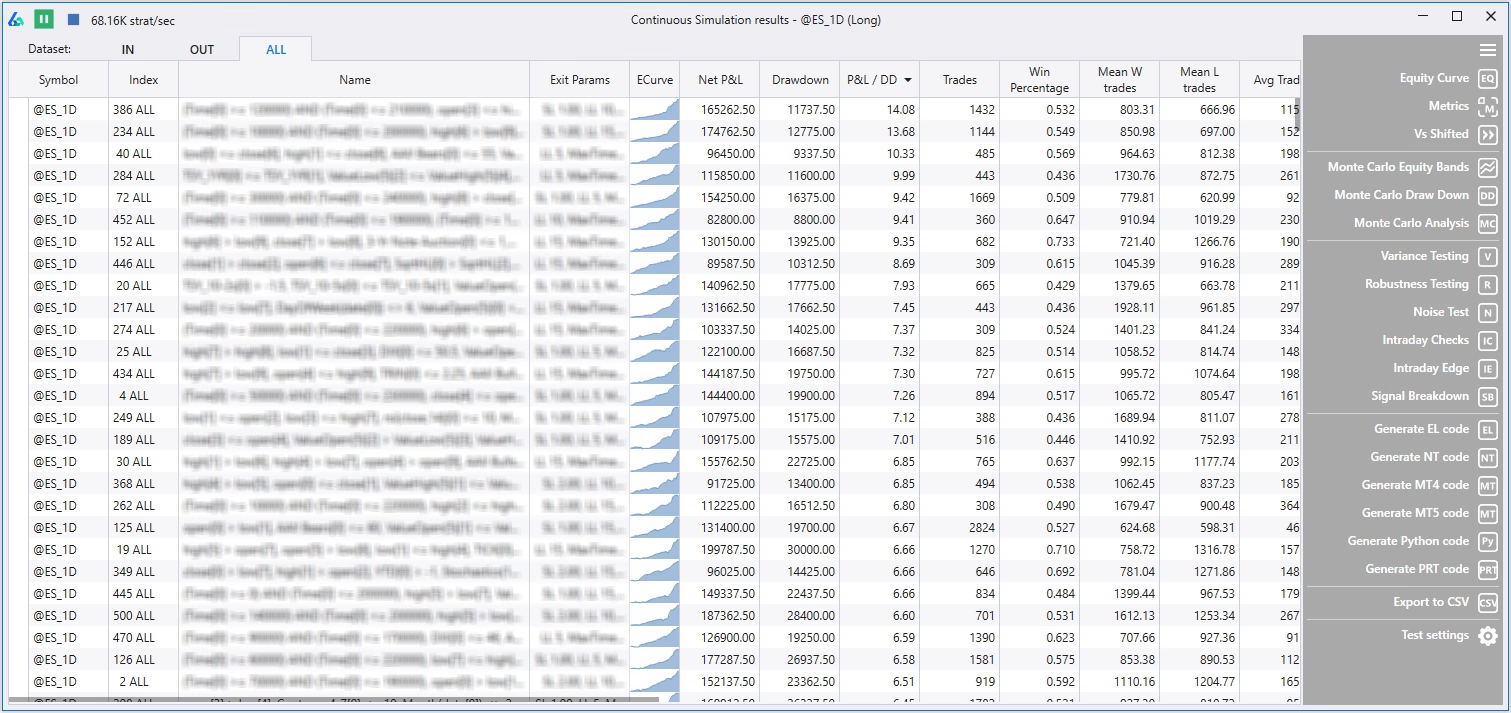
Build Alpha uses genetic algorithms to discover, validate, and export thousands of rule-based trading strategies. No coding required.