AI Generated Trading Strategies:
Reality, Hype & Performance
Everyone claims to be using AI to beat markets. But what does "AI-generated" actually mean? This guide separates reality from hype.
Table of Contents
- What Are AI Generated Strategies?
- The Hype Around AI Trading
- What AI Can Actually Do Well
- AI vs Rule-Based Generation
- Do AI Strategies Perform Better?
- The Overfitting Problem
- Degrees-of-Freedom Example
- AI + Genetic Algorithms Together
- AI Driving Strategy Platforms
- Institutional Reality
- Common Misconceptions
- When AI Makes Sense
- The Real Edge
What Are AI Generated Trading Strategies?
An AI-generated trading strategy typically refers to a system where machine learning models analyze historical data, patterns are identified algorithmically, signals are generated automatically, and execution follows predefined rules.
AI models may include neural networks, decision trees, gradient boosting, reinforcement learning, and deep learning architectures. However, the label "AI-generated" is often used loosely. Many so-called AI strategies are simply optimized rule-based systems, statistical models, genetic algorithm outputs, or automated parameter searches. True AI involvement depends on how the system is structured.
The Hype Around AI Trading
AI trading is often marketed as self-learning systems, fully autonomous profit machines, market prediction engines, and adaptive intelligence. Common claims include: "The AI evolves in real time," "The model learns every tick," "The system predicts future prices."
These statements are often exaggerated. Markets are noisy, non-stationary systems. Even the most sophisticated AI models operate within statistical constraints. AI increases modeling power, not certainty. AI does not eliminate market randomness, regime shifts, liquidity constraints, slippage, or structural risk.
What AI Can Actually Do Well
Detect Nonlinear Relationships
Machine learning can uncover relationships that simple linear models may miss in complex market data.
Rank Feature Importance
AI can help determine which inputs and indicators matter most for strategy construction.
Identify Market Regimes
Clustering models can separate volatility states or structural market environments.
Adapt Parameter Sensitivity
Meta-models can adjust hyperparameters dynamically based on stability feedback.
Enhance Signal Filtering
AI can reduce noise by identifying statistically weak conditions and filtering them out.
Generate Predictive Signals
Create new indicators and features that human designers may not conceive of.
AI is powerful when used as a research tool, not as a prediction oracle.
AI vs Rule-Based Strategy Generation
| Dimension | AI-Based Models | Rule-Based Generators |
|---|---|---|
| Output | Statistical predictions | Interpretable trading logic |
| Transparency | Often black boxes | Transparent rule structures |
| Validation | Harder interpretability | Fits robustness frameworks |
| Portfolio Fit | Requires feature engineering | Clean portfolio integration |
Many high-performing systematic traders favor structured rule generation combined with strong validation, rather than fully opaque neural networks.
Do AI Strategies Perform Better?
The honest answer: not automatically. AI strategies may overfit complex historical patterns, capture noise rather than signal, and degrade rapidly in live markets. The more flexible the model, the higher the overfitting risk.
Performance depends more on validation discipline, data quality, execution modeling, portfolio construction, and risk management, than on whether the model is labeled "AI."
The Overfitting Problem in AI Systems
AI models increase model complexity. Increased complexity increases degrees of freedom, curve-fitting risk, and parameter instability.
Without strict validation, automatically generated trading strategies and AI systems can show extraordinary backtests, then collapse in live trading. Rigorous validation includes:
- Out-of-sample testing
- Walk-forward validation
- Monte Carlo simulation
- Cross-validation
- Regime robustness checks
⚠ Critical Warning
AI without validation is sophisticated curve fitting. The more complex the model, the more critical rigorous out-of-sample testing becomes.
A Simple Degrees-of-Freedom Example
To understand why AI models overfit so easily:
Neural Network
trainable parameters
Training Data
observations (5 yrs daily)
When a model's flexibility approaches the size of the dataset, it becomes increasingly capable of fitting noise rather than signal. The result: extremely smooth backtests, high in-sample accuracy, rapid out-of-sample degradation. Without strict controls, AI systems memorize history instead of learning durable structure.
How AI and Genetic Algorithms Work Together
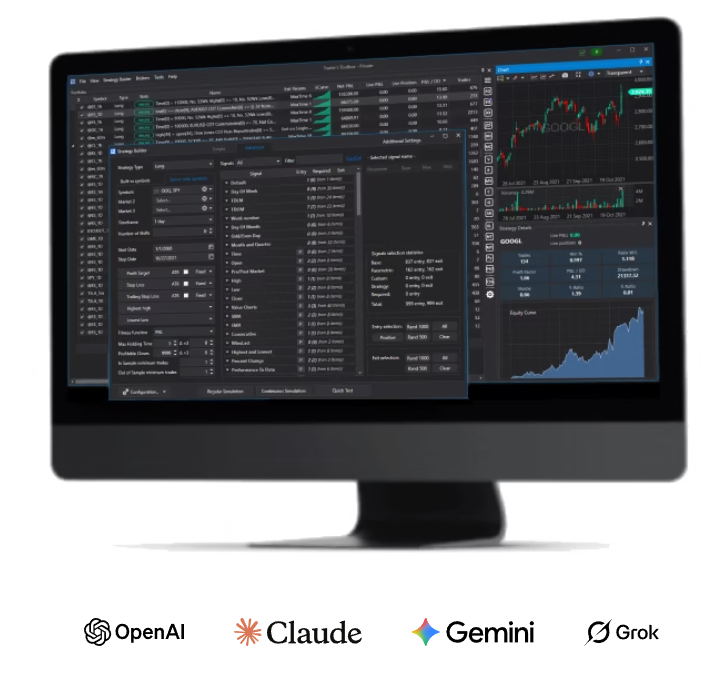
Rather than viewing AI and evolutionary search as competitors, they can operate at different layers. This is the approach taken by Build Alpha.
AI Layer
- Identifies predictive features
- Detects regime conditions
- Ranks feature importance
- Adjusts hyperparameters
- Guides search boundaries
Genetic Algorithm Layer
- Evolves rule combinations
- Optimizes parameters
- Applies mutation & crossover
- Scores via fitness function
- Produces interpretable logic
AI guides feature intelligence and search parameters. Evolutionary search structures strategy logic. Validation enforces robustness. This layered approach balances flexibility with interpretability.
Using AI to Drive Strategy Generation Platforms
Modern large language models (LLMs) and AI systems can operate as an orchestration layer for structured strategy generation platforms. In this architecture:
- AI defines the search box, which indicators, markets, timeframes, and constraints to explore
- Evolutionary search operates inside that box, generating candidate strategies
- Hyperparameters control how aggressively the search explores the space
- Validation frameworks filter fragile outputs
AI controls the inputs and boundaries. Evolutionary algorithms search within them. Robustness testing determines survival.
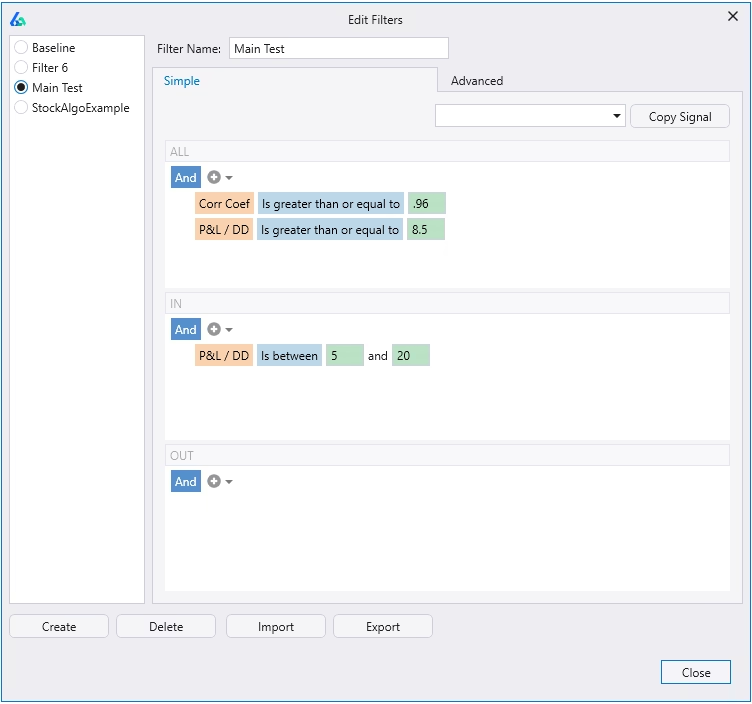
When integrated properly, AI becomes a strategic controller, not a blind optimizer. Platforms designed for automatic strategy generation serve as the structured execution engine, allowing AI to guide discovery while preserving transparency.
Institutional Reality
Many institutional firms use statistical learning, signal extraction, portfolio optimization, and risk modeling, but they also emphasize risk control, model monitoring, continuous research, and strategy replacement pipelines. AI is rarely a standalone "magic engine." It is part of a disciplined quantitative infrastructure.
Common Misconceptions About AI Trading
AI predicts the future
AI models estimate probabilities. They do not predict certainty.
AI eliminates human judgment
Humans design objectives, constraints, validation methods, and risk limits.
More complexity equals more edge
Complex models can increase fragility. Often simpler systems outperform in live markets.
AI adapts instantly to regime changes
Models must be retrained or regenerated. Adaptation is not automatic perfection.
AI removes risk
All trading systems carry risk, regardless of intelligence label.
When AI Makes Sense in Trading
✓ AI Is Most Useful When
- Data volume is large
- Nonlinear relationships matter
- Feature sets are complex
- Regime detection is valuable
- Meta-optimization is required
✗ AI Is Less Useful When
- Data is limited
- Interpretability is critical
- Execution constraints dominate
- Simpler models perform similarly
The Real Edge: Process Over Buzzwords
The strongest systematic traders focus on objective fitness functions, robust validation, portfolio diversification, controlled complexity, and continuous research.
Whether the strategy is labeled AI, evolutionary, or statistical is secondary. The primary advantage comes from disciplined process design. AI can enhance the process but not replace it.
Key Distinction
AI-generated strategies are one subset of automatic strategy generation. Automatic strategy generation refers broadly to structured algorithmic search, evolutionary trading strategy discovery, systematic rule construction, and scalable exploration. AI may operate within this framework, but it is not the entire framework.
Final Thoughts
AI-generated trading strategies are neither miracle machines nor marketing fiction. They are tools. Powerful tools, when used within disciplined research processes.
Performance depends less on whether a system uses neural networks and more on how objectives are defined, how fitness is designed, how robustness is enforced, how portfolios are constructed, and how risk is controlled.
In modern markets, sustainable edge comes from structured research pipelines, not buzzwords. AI can assist that pipeline. That's what I've built with Build Alpha.
Trading Strategy Generator Software →

David Bergstrom
A decade-plus in professional trading as a market maker and quantitative strategy developer at a high-frequency trading firm with a CME seat. Consulting for hedge funds, CTAs, family offices, and RIAs.
Frequently Asked Questions
What are AI generated trading strategies?
AI-generated trading strategies use machine learning models to analyze historical data, identify patterns algorithmically, generate signals automatically, and execute via predefined rules. Models may include neural networks, decision trees, gradient boosting, reinforcement learning, and deep learning architectures.
Do AI trading strategies perform better than rule-based systems?
Not automatically. AI strategies may overfit complex patterns, capture noise rather than signal, and degrade rapidly in live markets. Performance depends more on validation discipline, data quality, and risk management than on whether the model is labeled AI.
What is the biggest risk of AI trading strategies?
Overfitting. AI models increase model complexity, which increases degrees of freedom, curve-fitting risk, and parameter instability. Without strict out-of-sample testing and robustness validation, AI systems can show extraordinary backtests but collapse in live trading.
Can AI and genetic algorithms work together for trading?
Yes. AI can identify predictive features and guide search parameters while genetic algorithms evolve rule combinations across the <a href='https://www.buildalpha.com/strategy-search-space/' class='il'>strategy search space</a> using those features. AI guides direction, evolutionary search structures logic, and validation enforces robustness. This is the approach used by Build Alpha.
Is AI necessary for profitable systematic trading?
No. Often simpler structured systems outperform overly complex AI models in live environments. The strongest systematic traders focus on objective fitness functions, robust validation, portfolio diversification, and controlled complexity. AI can enhance the process but not replace it.
What Traders Say About Build Alpha
















Continue exploring: See examples of generated strategies, learn about strategy discovery methods, compare manual vs automated trading, or understand why generation matters more than optimization.
AI-Powered Discovery.
Validated Results.
Build Alpha combines AI intelligence with genetic algorithms, robustness testing, and portfolio construction. No coding required.