Manual vs Automated
Trading Strategies:
Which Performs Better?
The real question isn't "automation wins." It's: which approach is more scalable, testable, and adaptable in modern markets?
What Is Manual Trading?
Manual trading involves human decision-making, chart interpretation, pattern recognition, discretionary entries and exits, and real-time judgment. Manual traders rely on experience, market intuition, visual pattern recognition, news interpretation, and contextual analysis.
No two discretionary traders trade exactly the same way. Even with the same setup, execution varies.
What Is Automated Trading?
Automated trading uses predefined rules executed by software. A systematic strategy includes defined entry conditions, exit conditions, risk management rules, and position sizing logic.
Once rules are defined, the system executes trades consistently, removes emotional interference, allows historical testing, and enables portfolio construction. Automation can range from simple rule-based systems to automatically generated trading strategies using evolutionary search.
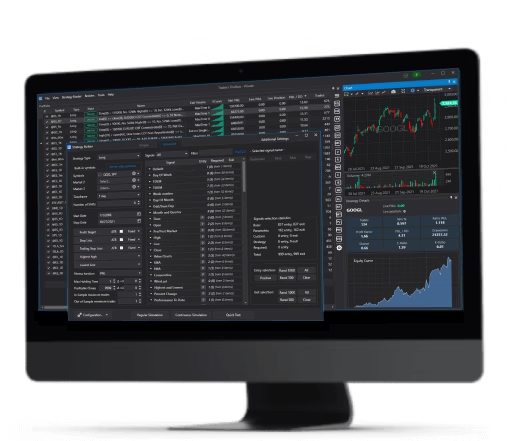
Performance: Which Produces Higher Returns?
Exceptional discretionary traders can outperform automated systems. However, discretionary performance is difficult to measure objectively because historical decisions may not be fully documented, emotional variance affects execution, and consistency is hard to quantify.
Automated strategies allow full historical backtesting, objective performance measurement, statistical evaluation, and reproducible results. The key advantage is not necessarily higher returns. It is measurable returns.
Consistency and Emotional Control
Manual trading is highly vulnerable to fear, overconfidence, revenge trading, hesitation, and overtrading. Even experienced traders experience psychological drift. Automated systems execute rules exactly as defined. They do not hesitate, override signals, or change position size impulsively.
Institutional Example: Renaissance Technologies
One of the most well-known examples of systematic trading is Jim Simons, founder of Renaissance Technologies. The Medallion Fund reportedly produced approximately 66% annual returns before fees over several decades, entirely model-driven. As Simons emphasized: "We don't override the models." (Interview clip)
Process-driven systems scale more reliably than intuition-driven execution.
Scalability
Manual, Constrained By
- Screen time
- Attention bandwidth
- Cognitive fatigue
- Handful of markets
Automated, Enables
- Multiple markets simultaneously
- Portfolio-level deployment
- 24-hour execution
- Dozens or hundreds of systems
Automation scales. Human attention does not.
A Simple Diversification and Scaling Example
Portfolio Sharpe when combining strategies with equal Sharpe and equal average correlation:
Sp = S / √( ρ + (1 - ρ) / N )
Where Sp = Portfolio Sharpe, S = Individual Sharpe (0.20), ρ = Average correlation (0.10), N = Number of strategies.
Even though each individual system is mediocre, combining many low-correlated systems nearly triples the risk-adjusted return. The improvement comes from diversification and scale, not better predictions.
Testing and Validation
Manual strategies are difficult to test rigorously. Historical chart review introduces hindsight bias, memory distortion, and selective recall.
Automated strategies enable rigorous statistical evaluation:
- In-sample testing
- Out-of-sample validation
- Walk-forward analysis
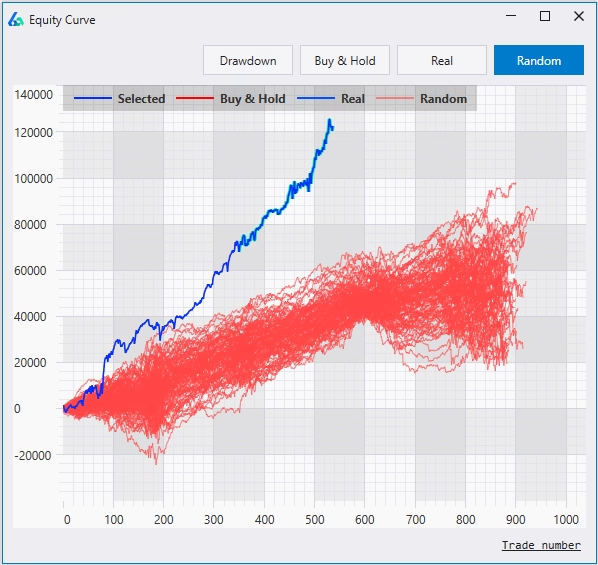
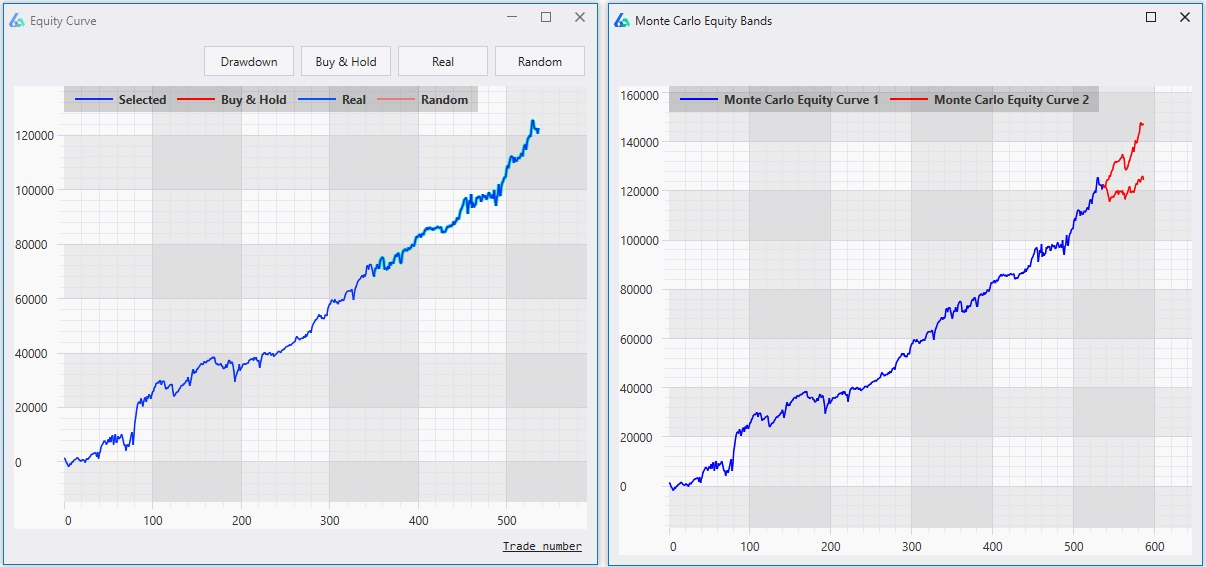
- Monte Carlo simulation
- Vs. random benchmarking
- Parameter sensitivity testing
This structured robustness testing is one of automation's strongest advantages.
Adaptability to Changing Markets
Manual traders adapt quickly to breaking news, regime shifts, and structural changes. Automated systems must be re-optimized, re-generated, revalidated, and adaptive by design.
However, automatic strategy generation allows for continuous discovery, strategy replacement, and portfolio adjustment. While manual traders adapt through intuition, systematic traders adapt through research pipelines. Professional operations increasingly use AI generated trading strategies.
Risk of Overfitting
Automation introduces overfitting risk, extensive optimization can produce strategies that perform well in-sample but fail live. Manual traders also overfit mentally, favoring recent setups, known as recency bias.
The difference is visibility. Automated overfitting can be measured and mitigated with out-of-sample testing, walk-forward validation, robustness analysis, and vs. random benchmarking. Discretionary overfitting is harder to detect.
Portfolio Construction
Manual Traders Focus On
- One primary strategy
- One market
- One timeframe
- One setup
Automated Traders Build
- Multiple uncorrelated systems
- Diversified portfolios
- Cross-market strategies
- Smooth equity curves
Portfolio construction smooths equity curves and reduces dependence on a single edge, one of the strongest structural advantages of systematic trading.
Time Investment and Learning Curve
| Dimension | Manual Trading | Automated Trading |
|---|---|---|
| Daily Effort | Continuous attention, active monitoring | Front-loaded research, periodic adjustment |
| Time Focus | Execution-heavy | Research-heavy |
| Core Skills | Pattern recognition, market feel | Statistical understanding, data literacy |
| Learning Style | Experience accumulation | Structured research mindset |
Can Manual and Automated Trading Be Combined?
Yes. Many traders use discretionary filters on systematic signals, automated systems for execution, or systematic portfolios alongside discretionary trading. Hybrid approaches leverage human contextual awareness, systematic consistency, and portfolio-level diversification. The choice does not have to be binary.
Which Performs Better in the Long Run?
Automation Excels In
- Scalability
- Validation
- Consistency
- Portfolio construction
- Measurable performance
Manual Excels In
- Contextual interpretation
- News-driven adaptation
- Flexible judgment
- Unusual market events
As markets become more competitive, structured systematic approaches often scale more reliably. The key advantage of automation is not raw profitability but repeatability.
The Strategic Shift
The real shift is not manual vs automated. It is intuition-driven vs process-driven.
Automatic strategy generation and systematic trading transform trading from: "I think this setup looks good" to: "This rule set has been statistically validated across multiple regimes."
Final Thoughts
Manual trading can be profitable in skilled hands. Automated trading can be powerful when built and validated properly. The difference is not whether a human or machine places the trade, the difference is whether performance is measured, repeatable, scalable, diversified, and validated.
In modern markets, structure often outperforms intuition. Not because humans lack skill, but because systematic processes scale more efficiently.
If you are looking for process and scale: Automated Trading Strategy Software →

David Bergstrom
A decade-plus in professional trading as a market maker and quantitative strategy developer at a high-frequency trading firm with a CME seat. Consulting for hedge funds, CTAs, family offices, and RIAs.
Frequently Asked Questions
Which performs better: manual or automated trading?
Exceptional discretionary traders can outperform automated systems. However, the key advantage of automation is not necessarily higher returns but measurable, repeatable, and scalable returns. In modern markets, structured systematic approaches often scale more reliably.
Can manual and automated trading be combined?
Yes. Many traders use discretionary filters on systematic signals, automated systems for execution, or systematic portfolios alongside discretionary trading. Hybrid approaches leverage human contextual awareness with systematic consistency.
Why is scalability an advantage of automated trading?
Automated trading allows multiple markets simultaneously, portfolio-level deployment, 24-hour execution, and parallel system operation. Combining many low-correlated systems can nearly triple risk-adjusted return compared to a single strategy.
Do automated trading strategies overfit?
Yes, overfitting is a risk. But unlike discretionary trading where recency bias is hard to detect, automated overfitting can be measured and mitigated with out-of-sample testing, walk-forward validation, Monte Carlo simulation, and vs random benchmarking.
What is the main advantage of automated over manual trading?
The main advantage is repeatability. Automated strategies allow full historical backtesting, objective performance measurement, statistical evaluation, and reproducible results.
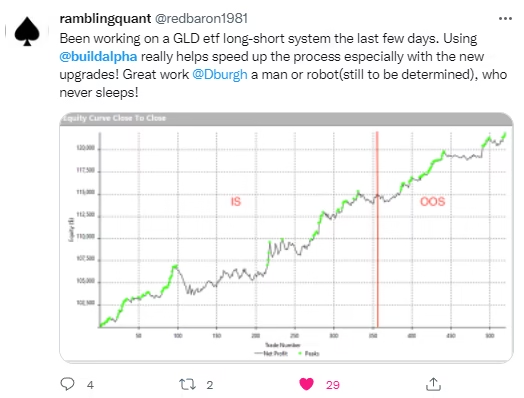
What Traders Say About Build Alpha














Go deeper: Learn how genetic algorithms power automated discovery, how fitness functions evaluate strategies, and why generation matters more than optimization. Explore the full systematic research workflow, understand the strategy search space, or see examples of generated strategies.
Move from Intuition
to Systematic Process
Build Alpha automates strategy discovery, robustness testing, and portfolio construction. No coding required.