I want to discuss three trading “truths” that I often heard but when I finally got into testing ideas found them to be myths. These discoveries were instrumental in turning my trading around.
For those that know my story, it was not all roses and rainbows – what trading story is?!? I actually “learned” like a lot of traders from online sources, chat rooms, webinars, and eventually found the right circles to roam in after a LOT of trial and error. I was then lucky enough to land a job with a high frequency trading firm. I was quickly made to realized that much of what I thought trading “was” was most certainly false.
In an attempt to show me the light, a few of the quick trading axioms they wanted to disprove to me were simple “well known” trading ideas that have been around for years but were in fact large falsehoods. I quickly realized beyond this list of three examples there must have been many, many more “trading truths” that were causing my account harm and doing my trading aspirations a disservice.
I then realized the value in testing everything and quantifying my entire approach. It wasn’t until this point in my journey did I get out of the “rat race” of trading… the ups and downs, the barely consistent, always doing slightly better but not really getting anywhere trading most of the traders I meet today are going through.
I cannot stress the importance of testing everything and quantifying your trading edge. Investigate these trading axioms. Otherwise, you will be stuck in randomness until your account random walks to 0. For more on my journey check out this podcast I did chatwithtraders.com/103
Below you will find my three favorite trading “truths” quantified.
Trading “Truth” #1 - Bearish Engulfing Candle
This one is great because many are familiar with Japanese candle stick patterns and the name implies such a negative move in price that one cannot help but to shift their bias to the downside. These candlestick patterns are often traders first introduction to technical analysis.
The pattern is defined as a bearish candle that “engulfs” the range of the previous day. I also like to look for a negative close and preferably a close below the previous session’s low. Here are a few pictures of bearish engulfing candles.
The truth is that this pattern has been one of the most bullish (not bearish) one day signals for the SP 500 over the past 15+ years. Did you know that the day following a bearish engulfing candle actually closes higher 61.72% of the time in the SP500 futures and 65.33% of the time in SPY ETF? The day following a bullish engulfing candle only closes higher 54.05% of the time in the SP500 futures and 51.70% of the time in SPY. You tell me why they’re named how they are!
Trading Truth #2 – Above a moving average is bullish and below is bearish
Most of the time this is true but it depends on the moving average, moving average length, and the market. I recently came across a few blogs that mentioned using a short term moving average as a sign to exit long market exposure and wait for sunnier days. In reality, this sounds great; however, analyzing the data this can be an extremely misleading “truth”.
Below is a chart plotting the equity curve if you would buy every close when the SP500 is BELOW the 8 period simple moving average (8SMA) and sell the next bar (repeating until above 8SMA). The second chart is if you were to buy every close when the SP500 is ABOVE the 8SMA and exit the next bar (repeating until below 8SMA). Yes, being below this moving average is actually better for long returns.
The point is that these trading truths like “above a moving average is bullish” and “below a moving average is bearish” need to be quantified and tested. It is important to stop thinking trading truths can be generalized to every market, timeframe, indicator value, etc. and just verify them yourself and you’ll be much better off!
Trading Truth #3 – Overnight Exposure is Risky
Sure earnings announcements and large unexpected news announcements typically happen after market close. Does this mean we should avoid trading overnight, if possible? So many want to day trade and be flat on the close that they miss a lot of gains from the overnight session (sometimes all of them).
Below you will see 30 top stocks where I breakdown their returns in the day session compared to the overnight session. The blue line signifies if you bought the open and sold the close the same day (day session) and the orange line signifies buying the close and selling on the next day’s open (simulating overnight exposure). As expected, there are no generalities in trading truths. Some stocks exhibit that most, if not all, returns come from the overnight.
Don’t get me wrong there are certainly edges to be had from avoiding overnight exposure and there can also be value added by increasing overnight exposure. Again, I am just making the point to dig deep into the data and understand where the edge(s) actually live.
Quick note: You can easily test overnight holds in Build Alpha by setting max hold to 1 bar and setting entry to this bar close and exit to next bar open in the settings menu.
In conclusion
Not all trading truths are “truths”. There are many that still have value! The edge is not in these truths but in determining the difference between a truth and a “truth”. Most do not take the effort to investigate these trading axioms found in trading books, blog sites, chat rooms, etc. If I have one goal then it is to make traders realize the value in testing everything – it is something I wish I would have started earlier. It is a super power to quickly test these ideas and trade/act accordingly!
I think many traders shy away from digging into the data because it requires effort and they think it will be a hard and arduous journey before they find some gold. But now I think it is increasingly easier than many may think.
That’s why Build Alpha’s main goal was (and still is) to make this type of testing easier for those with no programming skills or those tired of crunching endlessly in excel. The game is changing and things like this can be easily tested now. Now trading just comes down to those who will put in the work and who won’t: this should greatly increase your odds for success if you’re part of the former group.
Mean Variance Optimization [Portfolio Construction]
What is Mean Variance Optimization?
Here is the definition from Investopedia.com: “Mean–Variance analysis is the process of weighting risk (variance) against expected return. By looking at the expected return and variance of an asset, investors attempt to make more efficient investment choices – seeking the lowest variance for a given expected return or seeking the highest return for a given variance level.”
It also assumes investors are rational and would choose the asset that had lower variance if the expected return of two assets were equal. I will assume you all are!
In layman terms, there are many techniques of portfolio construction, but this test shows two things.
Does adding a strategy increase the overall risk:reward of your portfolio or not?
What are the appropriate weights each strategy in my portfolio should be assigned?
This is certainly a crude explanation of mean-variance optimization, but this isn’t an academic blog.
Testing Mean Variance Optimization
This test can be done with either historical or “predicted” returns. We will assign random weights to each of the strategies in the portfolio; the sum of all the weights shall equal 1 (or 100% of allocated capital). After assigning weights to each of the strategies we can generate a risk-adjusted return value or Sharpe Ratio. This is the Sharpe Ratio had we traded each of these strategies with the weight we just assigned to each.
After thousands of tests assigning random weights, we generate a plot of the thousands of Sharpe Ratios. We are trying to find the best weightings to lower the variance in our portfolio while keeping the return as high as possible. The leftmost dots create the Efficient Frontier and the leftmost dot is considered the minimum variance portfolio. The graph’s legend or color bar shows the highest Sharpe Ratio possible. This portfolio contains the three “checked” strategies on the far left of the photo below and the highest Sharpe from this portfolio is 2.17.
We can then hover over the graph and view the weights that produced a specific Sharpe value or dot on the chart. The idea here is we can see how to weight the strategies in our portfolio to give us the “optimal” or best risk-adjusted reward (optimal portfolio construction) – which is our ultimate goal as trading system developers.
The red dot shows equal weights or how our portfolio would have performed had we traded each strategy with the same position size.
Does this strategy improve my portfolio?
Now to answer the question “does adding this strategy to my portfolio help or hurt expected performance”? In Build Alpha’s portfolio mode, you can simply include or remove strategies and quickly see if the Sharpe Ratio increases or decreases with this Mean Variance analysis. Below I have selected one additional strategy (see four checks on the far left of the photo below) and you can see a Sharpe Ratio improvement from our original 2.17 to 2.50.
Adding new individual strategies will almost certainly “smooth” out the portfolio’s equity curve, but does it actually increase risk: reward? This test gives a simple, quick way to quantify the addition (or subtraction) of a strategy.
Next Test
Here I have changed the ES (S&P500 strategy) in the portfolio. I unselected the top ES strategy and selected the other ES strategy. You can see the Sharpe Ratio worsening as it appears this portfolio only achieved 2.28 (vs. previous portfolio configuration of 2.50). This is a good strategy but just does not work as well with the other strategies in the portfolio as the original ES strategy we had included.
Mean Variance Optimization Summary
We want our money to be as efficient as possible and this test or techniques of portfolio construction gives us another check if it is or not. No point in trading a strategy that is not expected to increase our overall risk reward.
It is now much simpler to compare strategies or to decide whether or not to include a strategy into a portfolio or not. Much of trading comes down to making informed decisions that maximize risk:reward and running this type of analysis certainly increases the information at your disposal. It is now only one click away in portfolio mode.
-Dave
PS: Build Alpha allows traders to import systems built outside Build Alpha for analysis and portfolio construction. Now you can do all of this analysis on Build Alpha strategies, your own strategies, or any combination between.
Author
David Bergstrom – the guy behind Build Alpha. I have spent a decade-plus in the professional trading world working as a market maker and quantitative strategy developer at a high frequency trading firm with a Chicago Mercantile Exchange (CME) seat, consulting for Hedge Funds, Commodity Trading Advisors (CTAs), Family Offices and Registered Investment Advisors (RIAs). I am a self-taught programmer utilizing C++, C# and python with a statistics background specializing in data science, machine learning and trading strategy development. I have been featured on Chatwithtraders.com, Bettersystemtrader.com, Desiretotrade.com, Quantocracy, Traderlife.com, Seeitmarket.com, Benzinga, TradeStation, NinjaTrader and more. Most of my experience has led me to a series of repeatable processes to find, create, test and implement algorithmic trading ideas in a robust manner. Build Alpha is the culmination of this process from start to finish. Please reach out to me directly at any time.
Free Friday #20 – Time Windows
There has been a recent popularity regarding time windows and it is one I completely agree with! There are certain structural changes that happen throughout the 24-hour session and as a trader it is important to take note of these when designing a system or strategy (or just placing trades). For example, how is my strategy’s performance when Asia closes? How about when the US opens?
There are also some blatant market anomalies that still exist regarding time windows. The most obvious one, and often popularized by Eric Hunsader of Nanex (and others), is the S&P500 futures performance from 2am to 3am. This little one-hour window looks like quite the edge – and has been persistent despite being publicly known for quite some time.
Using Time Windows to Trade
There are plenty of ways to use the time of the day to your advantage. For instance, only find trades/patterns that exist during a window of time where you might be at your desk. Another simple approach is to filter out unfavorable periods of the day to improve your performance (obviously proper testing methods important here).
My main point is… if you start paying attention to time windows you may be surprised as to what simple edges you’ll discover. It has certainly been a staple in my research for quite a while and I know many other successful traders who put a lot of emphasis on this.
Build Alpha Upgrades
I’ve recently upgraded Build Alpha to allow for intraday strategy creation and time window filtering (among other things). Inside BA you can now select (and create your own) time windows to use as input in the strategy creation engine. There is also a time of day test which allows you to select certain windows to see if it improves strategy performance.
Below is a simple strategy that shorts EURUSD (I used the futures contract) at 5:00 am EST every Wednesday, Thursday, and Friday morning. This idea simply holds the short trade for 3 hours.
These two might not be standalone strategies, but can certainly give you a head start for continued research, act as a filter for other strategies or be paired with other ideas to create fully operational strategies.
Trading is extremely competitive. Looking at price alone may be too naïve in today’s market; there is simply too much computing power looking at it. If you’re struggling to find quantified edges then maybe it is time (pun intended) to start pairing price action with time filters.
As always, thanks for reading. And please stay safe with all these hurricanes!
What is an intraday check? It is a phrase I am trying to coin, but I will explain the concept here..
There are certain rules (mainly for intraday strategies) that I believe should be applied to each strategy to check if there are any “hidden edges” in the underlying strategy.
Intraday Trading Checks
So what are these rules? And how can we test them? Well, Build Alpha now offers a test that allows users to test any intraday trading strategy to find out if it is as efficient as it can be or if there are any “hidden edges” within the strategy as I like to call it. Here are the additional intraday rules or checks.
Time windows. Is the strategy improved by only trading between certain times of the day?
Max Trades per day. A maximum number of trades per day count. Is the strategy improved by limiting the number of trades per day?
Minimum P&L per day. Is the strategy improved by limiting the amount of money it is allowed to lose per day? For example, automatically turn the strategy off for the day once you’ve lost $500 today.
Maximum P&L per day. Is the strategy improved by stopping the trading when an amount of money is earned per day? For example, automatically stop trading for the day once you’ve made $2,500 today.
Obviously, these tests are common and obvious ideas to look for hidden edges and strategy improvements – and of course, with all things, we need to use proper data analysis techniques (in vs out of sample, sample size, etc.) which I am not going to get into in this post as I have other posts regarding that.
Test Setup in Build Alpha
The Intraday Checks test can be easily configured by clicking on the “Test Settings” button and configuring the right-hand side of the pop-up window seen below:
The coolest feature of this addition to the software is the ability to add any of the newly found rules to the generated code for any of the supported Build Alpha platforms. For example, if you find a rule (or few rules) that improves the original strategy then you can double-click the test result and BuildAlpha will automatically incorporate those rules when generating trading code for TradeStation, MultiCharts, Ninjatrader or MetaTrader.
Build Alpha Intraday Checks Example
Here is a photo after selecting (double-clicking) on a test result which would then add this test’s rules to the exportable code. The highlighted red (selected) strategy’s rules can be seen at the bottom of the graph.
This selected strategy would add the rules
Max Trades per day: 2
Only take entries between 2:00 am and 12:00pm
Stop trading each day after losses reach $1,000 per day
Finally, the histograms below the graph show the distribution of all the tests on the intraday rules. This is important to make sure you’re not just selecting an outlier but that the underlying distribution/simulation itself was strong. Again, this post is not meant to get into selection bias and other potential pitfalls as I have other content about that.
All in all, it is important to search every nook and cranny to make sure we’re not leaving money on the table or missing an easy edge or strategy filter. This test aims to help in that regard.
For those interested in more Intraday Trading tools take a look at the Intraday Edge test.
A crazy cool way to use Build Alpha. I have to admit that I did not come up with this idea, but it was suggested to me by a Build Alpha user.
He was wondering if Build Alpha could help come up with some rules of when he should avoid trading his existing strategy or even when to fade his existing strategy. Heck any improvement is a plus, right?
**Please note Build Alpha now accepts data in this format: mm/dd/yyyy, hh:mm, open, high, low, close, volume, OI. Please refer to buildalpha.com/demo page for adding own data instructions**
*I say we found one strategy but we actually found tons that would be an improvement to his original strategy. Him and I only spoke specifically about one so that’s why in the video I slip and say we found one strategy. Did not feel like making a new video to clarify this minor point.*
Example Walkthrough
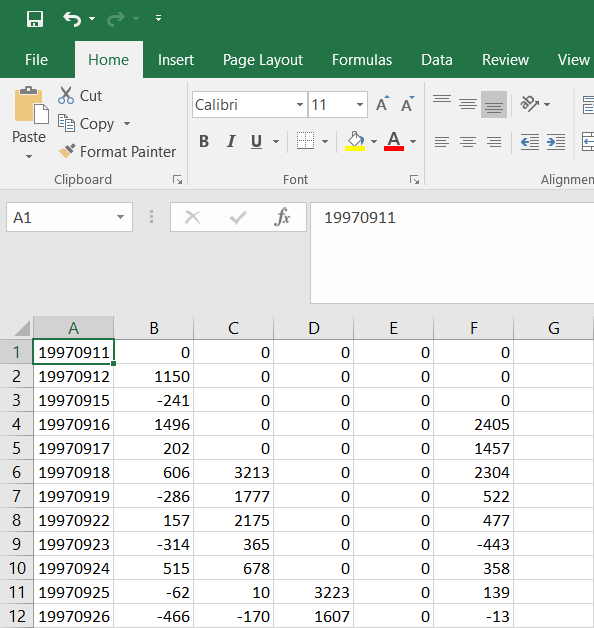
He had a day trading system and compiled profit and loss results for that system in the following (Build Alpha accepted) format. Date, time, open, high, low, close, volume. (*note BuildAlpha now accepts the time column as intraday capabilities are becoming fully operational*).
Below is his sample file. We purposely left the open (high and low) columns as all 0’s. The close column contains the end of day p&l from his original strategy.
We then set Build Alpha to have a maximum one bar holding period and to ONLY enter on the next bar’s open and to the ONLY exit on the next bar’s close. I will explain why this is in a minute.
We then chose the underlying symbol the original strategy was built on as market2 in the upper left of the main screen. For example, his original strategy trades ES (S&P500 Emini futures) so we only select Build Alpha signals calculated on Market2 which is set for ES.
So now if Build Alpha calculates a rule on ES-like close[0] <= square root(high[0] * low[0]) then we would “buy” the next bar’s open of market1 (again his results – which are 0) and “sell” the next bar’s close of his results which is the original strategy’s p&l for that day. This would essentially say that if this rule is true then go ahead with a green light to trade the original strategy the next day. If the rules are not true, then don’t trade the original strategy the next day. Ideally, we can find rules that increase risk-adjusted returns for the original strategy (which we did).
Fade the original trading strategy?
Now, what is even cooler is if we set Build Alpha to find short strategies we would essentially be “fading” his original strategy or finding rules of when to go opposite his original strategy.
Build Alpha found some good short/ “fade” rules to use as well. Here is an example that did quite well selectively fading his original strategy (even out of sample – highlighted section).
After emailing him the results here is what he had to say in his email response:
“There are 2028 negative periods in my data with a gross loss of -1,217,880.26. That’s the theoretical maximum a short rule can achieve, if it were to find all losses. Your graph seems to show 380,000 short rule profits. That’s already 31% of all losses. If I don’t trade on these days, my net profit would go up by 380,000, a 46% increase.”
I thought this was a really unique way to use Build Alpha and I wanted to share. I think the same analysis can be done on strategies with longer holding periods, too. I would just import daily marked to market results of the original strategy and Build Alpha can find rules of when to hedge your strategy or fade it for a day or two. I think this is certainly a unique approach to add some alpha to performance.
Anyways, thanks for reading as always and keep a lookout for some MAJOR upgrades coming to Build Alpha very soon!
$70,000 in profits in just 3 months. A Build Alpha testimonial
This is hands down the best email I have received since launching the BuildAlpha software a little over six months ago. It is a thank you note sent from a Build Alpha user, Madhur, who licensed the software back in March 2017 and has grown his account about $70,000 in that span (or about +55.92%).
Below is a photo of the email he sent and his account statements verifying his amazing first three months of trading while using the software.
What is amazing is that Madhur is/was a discretionary or hand trader! That’s right, he’s found a way to combine what he was already doing and the systematic edges that the Build Alpha software can find to further increase his OVERALL edge in the markets.
I love this story for so many reasons. First, it shows that finding a trading edge is vital regardless if you choose to automate your execution or not. Second, Build Alpha is a trading tool and not necessarily a system trading tool (albeit geared toward system traders no doubt). Third, Madhur found a unique way to incorporate the old with the new to make something better – a lesson for all traders (myself included).
I have received tons of emails of Build Alpha success and thank you notes, but none as specific as this one. It is hard to market user success without the proof otherwise you all would have your doubts (rightfully so) – but after receiving this I cannot help but feel proud and share.
Congrats Madhur and the other successful Build Alpha users out there! Thanks for pushing my development of the software and continuing to support me with this pursuit.
Also, please read all the disclaimers. I am not guaranteeing that if you license the software and poof 3 months later you are up big. No one can promise anything in this game – I just wanted to share a story that put a smile on my face and makes all the development hours worth it!
Thanks for reading
Dave
Free Friday #19 – Long/Short Small Caps and June Update
This Free Friday, Free Friday #19, is a user submission! It is a long/short strategy for $IWM – the Russell 2000 ETF. Both the long and the short strategy only have two rules each and only hold for 1 day. Below I’ve posted the long strategy on the left and the short strategy on the right. Short edges have certainly been difficult to find over the past few years in the US equity indexes on a daily time frame, but one hopes they’ll pay for the effort when/if things turn south!
Both strategies were tested from 2002 to 2017 using 35% out of sample data. All performance is based on only a simple 100 shares per trade. *1 S&P500 futures contract is equivalent to about 500 $SPY shares for reference*
There is also $SPY (green plot) and $TLT (gold plot) plotted to see how the strategies would have performed on these markets as well; the strategy maintains profitability in both cases.
The long strategy rules are simple and all trades exit at the next day’s open.
Day number is greater than 5. Today is June 30, 2017. Today’s day number is 30.
High[3] <= Low[7]
The short strategy rules are simple as well and all trades exit at the next day’s open.
Close[3] > Low[6]
Close[0] > 8 Period Simple Moving Average
Below there is a photo of the long/short equity performance for this simple portfolio.
I also want to add an update to some of the Free Friday strategies. Things were pretty quiet for most of the futures strategies other than the equity index strategies this month.
Strategies #5, #6, #16 were the only futures strategies that traded so I wanted to show their June performance below.
Again, all are just trading 1 contract for demonstration purposes and were posted publicly months ago. You can see the strategies on twitter here: @dburgh
Thanks as always and have a Happy Fourth of July,
Dave
Thanks for reading, Dave
Free Friday #18 – Building a Strategy with Open Interest
What is Open Interest?
Open Interest is just the total number of outstanding contracts that are held by market participants at the end of each day. All derivatives have Open Interest. That is, both futures and options have their own Open Interest.
For example, the March SP500 e-mini futures contract can have its own Open Interest while the March 4000 Strike Call option can also have an its own Open Interest.
Open Interest is a proxy for cash flowing into the market. If Open Interest increases, then more money is moving into the market whereas Open Interest declining could be seen as cash leaving the market.
How is Open Interest Calculated?
Open Interest is calculated by adding all the contracts from opened trades and subtracting the contracts when a trade is closed.
For example, Steve, Chris, and Clay are trading the same futures contract. If Steve buys two contracts to open a long trade, open interest increases by two. Chris also longs four contracts, thus increasing open interest to six. If Clay puts on a short trade of three contracts, open interest again increases to a new total of nine.
Open Interest would remain at nine until any traders exit positions, which would cause a decline in open interest. If Steve sells both of his contracts and Chris exits two of his four contracts, then open interest would decrease by four from nine to five.
What is the difference between Open Interest and Volume?
Both are similar as they count total contracts traded. However, volume is a count of all traded contracts and open interest is a total of the contracts that remain open.
If a trader buys one contract, then both volume and open interest are one. If the trader sells the contract, then volume is two and open interest is zero. Volume is a running total of all transactions and Open Interest is the total of all open positions.
Is higher or lower Open Interest better?
Better is relative to your current market view or position. However, typically higher open interest is good because it signals more interest in a particular contract or strike price and may also signify that there is more available liquidity (i.e., exiting shall be easier and you may experience less slippage).
On the other hand, lower open interest may be a positive too. If the market moves or news comes out in favor of your existing position, then many traders may need to pile into your same trade pushing price in your direction.
When in doubt, test your ideas on whether higher or lower Open Interest is better. That is what Build Alpha is for! Stay tuned for an example strategy later.
What is an Open Interest strategy?
A trading strategy that relies on Open Interest as an input signal or filter can be considered an Open Interest trading strategy. For example, if Open Interest rises by x% then buy or if Open Interest is greater than the N-day average, etc.
There are a ton of creative ways to incorporate Open Interest data into your algo trading strategy development process. Creativity is often a source of alpha!
Open Interest Trading Strategy Example
As always, happy Friday!
This week I was asked by a Build Alpha user if he could build strategies using a contract’s Open Interest. Open Interest is just the total number of outstanding contracts that are held by market participants at the end of each day. So, it is intuitive that as more contracts are opened or closed then it might be telling of how traders are positioning.
This is a detailed and advanced post. Build Alpha is all point and click, but this is certainly a way more advanced blog post showing how a more sophisticated user can utilize the software.
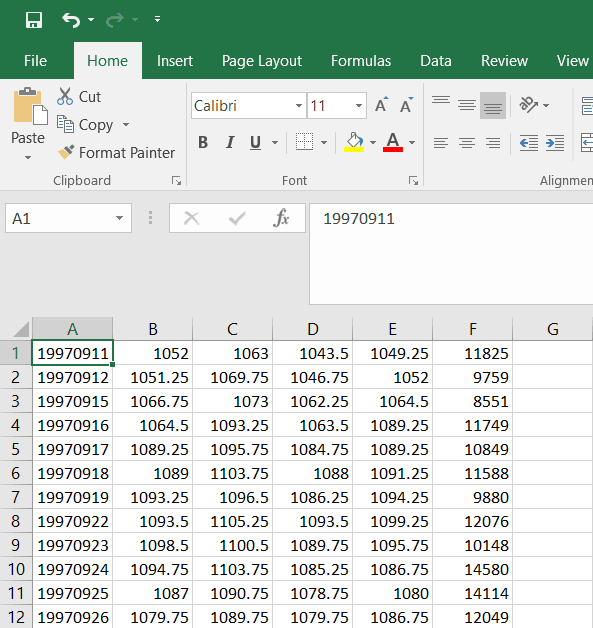
I have to admit this is not something I have looked at previously so I was quite intrigued, but I pulled some open interest data from TradeStation and saved it.
Structing Open Interest Data
I then went on to create columns I – M below. Columns I-L are momentum measures (N period change) of Open Interest. For example, column J holds the Open Interest change over the past 5 days. Column K holds the Open Interest change over the past 10 days. Column N just holds the 3-bar sum of the 1-period momentum of Open Interest. The data can be seen below opened in Excel (I know who uses Excel anymore).
In order to use the above data in BuildAlpha, we need to format two separate files. First, we need to create a date, open, high, low, close, volume file of the actual S&P500 futures data (columns A, C, D, E, F, G). I copy and pasted those columns to a new sheet and then reformatted the date to YYYY/MM/DD, removed the headers, and saved it as a .csv file. Pictured below…
I then copy and pasted our dates and custom Open Interest data to a new excel sheet. This time instead of having the date, open, high, low, close, the volume we’ll use (copy) the date, 1-period OI change, 5-period OI change, 10-period OI change, 20-period OI change, 3 bar sum of OI as our six columns.
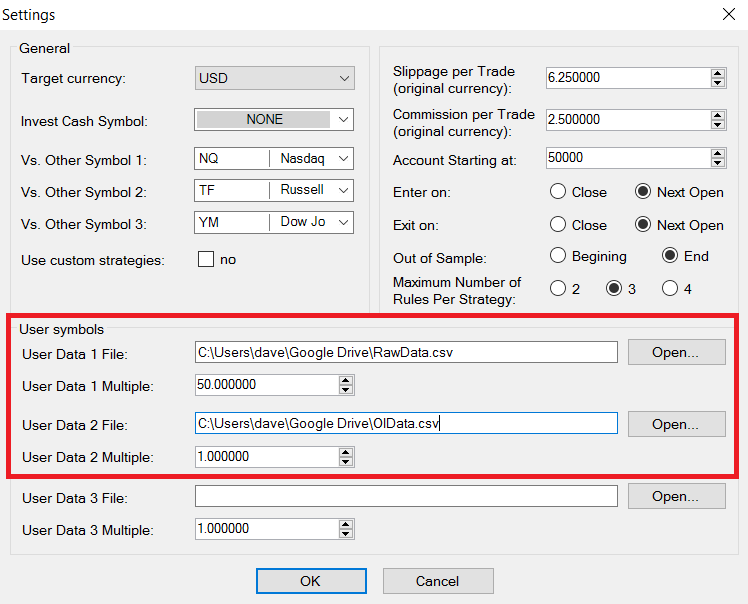
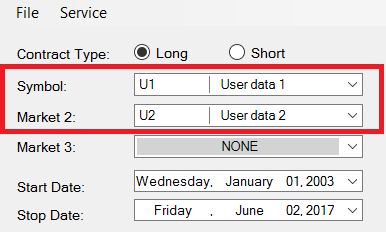
We can now pass this data into Build Alpha and build strategies using the Intermarket capabilities. However, in this case, our intermarket or Market 2 will be this custom open interest data and not some other asset.
Video Examples
The two videos below show exactly how I did this process in case you didn’t follow my Thursday night, two glasses of scotch deep, blog writing.
Build Alpha Open Interest Strategy Example
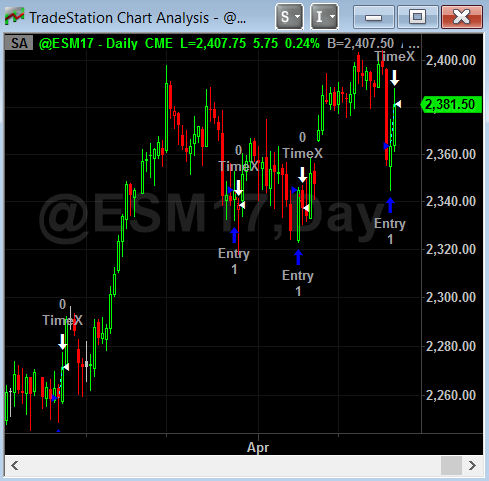
There is a different strategy displayed in the video above, but I promised some guys on twitterI’d share the strategy I posted Thursday. So below is the actual Free Friday #18. It holds for one day and trades when these conditions are true:
**S&P500 Futures strategy built on open interest data only and tested across Nasdaq, Dow Jones, and Russell Futures. Results just based on 1 contract**
So the last rule in Build Alpha would appear as Low2[0] > Low2[1] or translated as the low of Market 2 is greater than the low of Market 2 one bar ago. However, if you remember we created a custom data series for Market 2 and in the low column, we inserted the 10-period momentum of open interest!
Like I said this is a confusing post, but a really neat idea of how creative you can be with this software. The possibility of things we can test are immense.
Furthermore, when Build Alpha calculates RSI or Hurst, for example, using the close price of Market 2 (our intermarket selected) it will actually calculate RSI or Hurst on 20 bar momentum of the Open Interest (what we passed in for the close column)! You can also use the custom indicator/rule builder on these custom data columns.
You can also run strategies built on custom data like this through all the robustness and validation tests as well.
All in all, thanks for reading. I thought this was a cool idea taking system development to a whole new level.
In this Free Friday post, I want to pose a poll question. After reading the post and viewing the graphs please respond to the poll below and I will publish the results in another post later next week.
The question is… would you trade this strategy?
First, let’s go over the strategy. The strategy was designed using GBPAUD spot data and only has three rules to determine entry. The simulation to create this strategy (and hundreds of other strategies) took less than 2 minutes.
Vix[0] > Vix[1] – Remember [1] means 1 bar ago
High[4] <= Close[6]
Low[6] <= High[8]
The strategy has two exit criteria. A 1.5 times 20 Period ATR profit target and 1.0 times 20 period ATR stop loss.
Here are some simple performance measures
January 1, 2003 to May 1, 2017 (Last 30% Out of Sample)
Profit $147,626.20
Drawdown $8,289.70
Win Rate 54.50%
Trades 198
Sharpe 1.78
T-Test 3.76
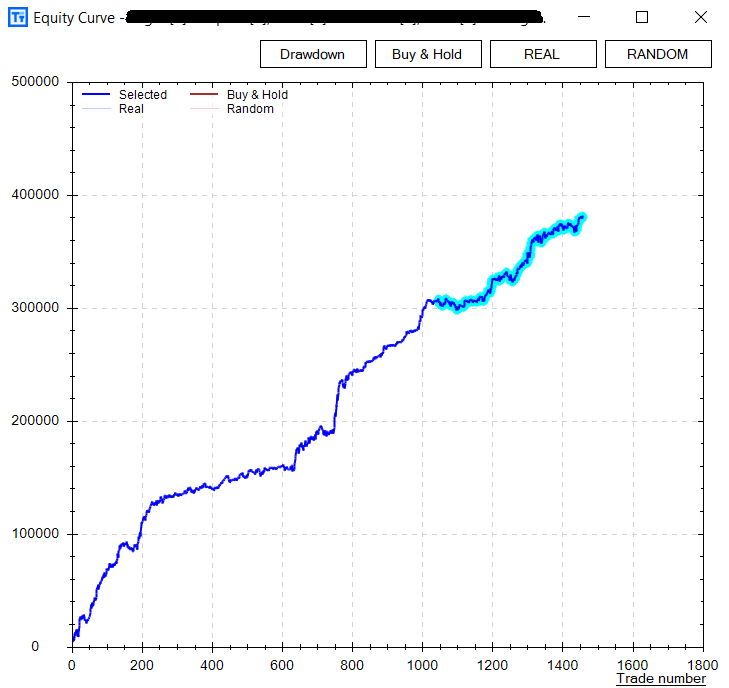
Here is the strategy’s equity curve on GBPAUD. You can see the short strategy continues to perform in the out of sample period (highlighted portion of the blue line).
I’ve also plotted how the strategy performed on three other markets. It remains profitable on Crude Oil futures, Canadian Dollar futures, and AUDUSD spot. Generally, we like to see profitability across markets and assets. However, how good is good enough to pass the test?
Next, I want to share the randomized Monte Carlo test. This test re-trades the strategy 1000 times but randomizes the exit for each entry signal. It is a test to see if we have curve-fit our exits and if our entry is strong enough to remain profitable with random exits. We can see the randomized Monte Carlo test maintains general profitability. Some fare better and some worse.
Next I want to share the Noise Test. This test adds and subtracts random amounts of noise (percentage of ATR) to user-selected amounts of data creating 100 new price series with differing amounts of noise. The test then re-trades the strategy on these 100 new price series to see if profitability is maintained on price series with differing amounts of noise. You can see here that as we change the noise the performance degraded a bit and there are some signs of curve-fitting to the noise of the original price series.
Next, I want to share the forward simulator or variance testing results. In this test, we simulate the strategy forward but assume the winning percentage will degrade by 5% (user defined % in test settings). This is a useful test because things are never as rosey as our backtest results. Now we can get an idea of how things can play out in the future if the strategy were to win x% less than it did in our backtest. This is good for setting expectations of where we expect to be in the next N trades as well.
Risk of Ruin was set to $10,000 for this test. So interpreting these results… if the winning percentage in the future is 5% lower than our backtest than 23% of our simulations will have a drawdown of 10,000 or more.
This is all the information I want to provide for this poll. There are plenty more tests and information we can gather (like E-Ratio), but I want to avoid analysis by paralysis. Build Alpha licenses come with access to a 20+ video library where I explain what I look for in all the tests and features offered by Build Alpha.
If you answered yes to this poll and have a BA license then you can now generate trade-able code for MetaTrader4 in addition to the original TradeStation, MultiCharts, and NinjaTrader.
I also hope all you ES (S&P500) traders that email me caught the dip last Friday like the first Free Friday strategy did (pictured below). I posted this strategy on Twitter in 2016 and it only holds for 1 day. I know a few of you have adjusted the logic and I’m hoping you caught the whole move to new highs!
The role of luck in (algorithmic) trading is ever present. Trading is undoubtedly a field that experiences vast amounts of randomness compared to mathematical proofs or chess, for example.
That being said, a smart trader must be conscious of the possibility of outcomes and not just a single outcome. I spoke about this in my Chatwithtraders.com/103 interview, but I want to reiterate the point as I am often asked about it to this day.
The point I want to make is that it is very important to understand the distribution your trading strategy comes from and not just make decisions off the single backtest’s results. Doing so can increase a trader’s “luck”.
In the interview I spoke about this graph below that shows two different trading systems that have very similar backtests. The black line on the left represents system A’s backtest and the black line on the right represents system B’s backtest. For our intents and purposes let’s assume the two individual backtest results are “similar” enough producing the same P&L over the same number of trades.
The colorful lines on the left is system A simulated out (can use a variety of methods such as Monte Carlo, Bootstrapping, etc.) and the colorful lines on the right is system B simulated out using the same method. These are the possible outcomes or paths that system A and system B can take when applied to new data (Theoretically – read disclaimers about trading).
These graphs are the “distributions of outcomes” so many successful traders speak about. This picture makes it quite obvious which system you would want to trade even though system A and system B have very comparable backtests (black lines).
*There are many ways to create these “test” distributions but I will not get into specifics as BuildAlpha does quite a few of them*
Another View
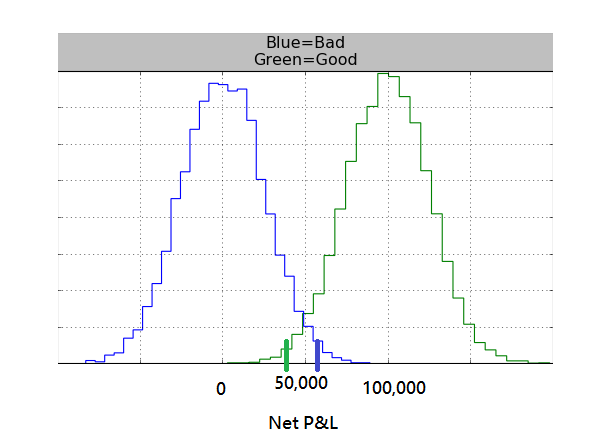
This second example below demonstrates this point in another way but incorporates the role luck can have on your trading. Let’s say the blue line is the single backtest from System A (blue distribution is all possibilities). The single green line is the single backtest from System B (green possibilities).
In this graph, you can see that System A (part of the blue possibilities) was lucky and performed way better than most of the possibilities and of course better than the single backtest for System B.
You can also see that System B (part of the green possibilities) was extremely unlucky and performed way worse than most of the green possibilities.
Moving forward… do you want to count on Mother Market to give system A the same extremely favorable luck? or do you want to bet on system B’s luck evening out?
I always assume I will be close to the average/median of the distribution moving forward which would put us at the peaks of both of these possibilities or distributions… if that is the assumption then the choice is clear.
Update Announcement
Build Alpha licenses now come with an instructional video series or course that goes over all the features and how to use the statistical tests the software offers. It makes spotting systems and their related distributions much easier than Build Alpha already makes it.
Curve fitting or more commonly referred to as overfitting is creating a trading strategy that is too complex that it fails to adapt to new market data. Said another way, curve fitting is a trading strategy that shows a great backtest but fails on live data or as market behavior changes.
Curve-fitting is the fastest death for a trading or investment account once actual trading begins. Adding too many parameters and filters to improve your backtest feels good but rarely helps actual trading results in live markets.
Finding the perfect set of parameter settings to produce the perfect profit graph of past performance during strategy testing is a sure-fire way to curve fit and ultimately deplete your trading account.
Curve fitting is the black plague for system traders. The initial investment is often better donated than trading overfit strategies based on bloated hypothetical performance results.
In short, curve-fitting is finding patterns that are actually just random noise. As the curve fit trading strategy sees new data it will mistake random noise for predictive patterns causing trading losses. Preventing curve fitting and finding statistically significant patterns may be the key to your trading career.
Why do Automated Trading Strategies Fail?
Most automated trading strategies fail due to curve fitting or overoptimization. There are numerous other factors, but overfitting and overoptimization are the prime suspects.
Beginning traders hunt for the holy grail strategy and get excited over “too good to be true” backtests or hypothetical trading results. Many think a profitable backtest means a license to print money and no financial risk.
Many say, “If I could find a set of rules or parameters that does well historically on a specific trading program then I will be set to achieve profits”. Unfortunately, the markets and trading do not work this way.
Too many algo traders focus on finding the perfect trading strategy based on hypothetical performance results with the highest profit instead of finding robust strategies that can withstand losses moving forward.
Robust strategies are ones that can withstand changes in market behavior and are not sensitive to small parameter changes (i.e., possess parameter stability). Additionally, robust strategies should pass a series of robustness tests that many traders are unaware of.
Here are the 3 simplest ways to lower or avoid curve fitting risk
1. Out of Sample Testing
Out of Sample testing is simply withholding some data in your historical data set for further evaluation. For example, you have ten years of historical data and opt to put the last 30% in your back pocket.
You develop a great trading strategy on the first seven years of the data set – the in-sample data. You add filters, subtract rules, optimize parameters, etc. Once the strategy results are acceptable, whip out your “out of sample” data (the remaining 30% from your back pocket) and validate your findings.
If the strategy fails to produce similar results on the out of sample data, then you can be almost certain you have curve-fit to the first seven years of your data set.
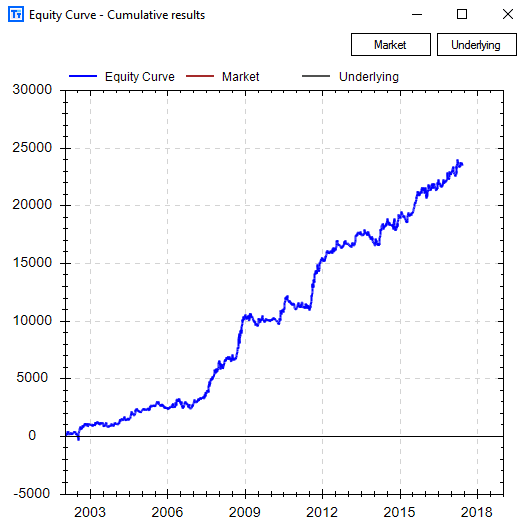
Below is a chart of an example strategy built using Build Alpha that highlights the out of sample period.
You like to see similar growth (and performance metrics) in both the in-sample and out-of-sample periods as sharp differences are often a red flag the hypothetical trading record was misleading.
On the other hand, successful OOS results are not necessarily indicative of future results and still involve financial risk but are a great first step to avoid overoptimization.
To read more about Out of Sample testing check out these blogs:
The second example of how we can reduce overfitting and hopefully our financial risk is to make sure your strategy has enough trades. If you flip a coin 10 times and it lands on heads seven times you cannot be certain you do or do not have a rigged coin.
However, if you flip a coin 10,000 times and it lands on heads 7,000 times then you can have high confidence it is a rigged coin.
Below is a photo of only 30 coin flips and below that is a photo of six different trials of 100,000 coin flips. You can see after a large number of flips things tend to converge toward the true expectation or their expected value. This is known as the Law of Large Numbers.
Trading Example
Let’s take this particular trading program below; it has a remarkably smooth cumulative profit graph and averaged $170 in profit per trade.
However, if we track this trading strategy’s average trade over time, we can see that in the beginning, when our trust in the trading system is lowest, it is a bumpy ride and far from the $170 per trade average. It takes about 100 trades for the average trade to converge to the actual results or average we expect!
Most traders cannot stomach this short-term “randomness” and abandon ship. Traders that fall prey to strategy hopping never achieve profits and sadly never find out why. They never escape this short-term randomness.
My mentor explained this short-term randomness, long-term obviousness concept to me and a lightbulb clicked.
Escaping Randomness was the perfect title of my Chat with Traders interview where I discuss how to overcome trading randomness and why algorithmic trading can help traders think about markets and risk-taking in a more productive way. If you haven’t already, please check out Aaron’s wonderful work here: Escaping Randomness with David Bergstrom
3. Validate Across Other Markets
Test your trading system across other markets. If a particular trading program only works on one market, then it has a higher chance of being overfit than if a strategy performs profitably on a handful of markets.
I am not saying that a trading strategy that only works on one market is curve-fit – as there are many nuances, different players, and idiosyncrasies that exist within each market.
However, if a trading strategy performs across markets, then in such cases you can certainly have higher confidence that it less likely curve-fit than a strategy that only performs well on one data set.
A sign of robustness is the ability to generalize to other data and withstand losses or is at least generally prepared for changes in the data.
Testing across similar markets is an easy way of quickly getting a sample of how well a strategy generalizes to new data sets.
Think of the cat picture above. If we provide new data is this algorithm going to draw a dog? It is most likely not the next series of points. Testing on a new data set and not finding other animals would indicate that the cat was probably random.
Other methods to catch Curve Fitted Strategies before live trading
I cover most of these in the aforementioned Robust Trading Strategy Guide but here is a popular list for those eager traders looking for more than the three simplest material points to combat curve fitting risk.
These robustness checks identify curve fitting and overoptimization before the market does:
Vs Shifted
shift the start and stop time of each bar slightly. Re-trade the strategy on the shifted data sets. For example, hourly bars from 11:03 to 12:03 instead of 11:00 to 12:00.
Vs Noise
add and subtract random noise amounts to the market data. Re-trade the strategy on the noise adjusted time series
Vs Random
data mine for the best possible random strategy. Your strategy should beat this random benchmark if it contains true market edge
Monte Carlo Analysis
reshuffle and reorder the hypothetical trading results to see various paths the strategy could have taken. More on Monte Carlo Simulation here.
Variance Testing
resample from trade distribution only keeping strategies that have a performance metric some percent lower than the original backtest
Parameter Sensitivity Testing
trading systems that fail to show positive performance as parameters change are often curve fitted. For example, a moving average of 12 works but parameters of 11 and 13 result in substantial trading losses or losses similar to a random strategy.
Delayed Testing
trading strategies that cannot perform similarly with slightly delayed entries or exits are potential substantial risk candidates
Liquidity Testing
trading strategies that are capacity constrained and cannot handle large amounts of capital are also potentially over fit models that will fail in live market trades
How can I reduce the risk of Curve Fit Strategies with Build Alpha
Build Alpha is professional algorithmic trading software that generates, tests and codes trading algorithms with no coding necessary. It is truly a no code algo trading software rich with features.
However, a large part of my research and testing over the past decade-plus of professional trading experience and software development has helped me develop and integrate these robustness tests into one piece of software – that is Build Alpha’s strength.
Build Alpha has all of the above listed tests available at the click of a button for use on any trading system it generates.
In plain English, there are many inherent limitations, and no amount of stress testing can completely account for curve fitting risk; however, as traders, all we can do is attempt to lower the probabilities that we have fit the data. Powerful software like Build Alpha exists to help traders easily test and validate trade ideas prior to exposing them to the market.
Many factors related, but avoiding overly optimistic hypothetical performance results, strategies with frequently sharp differences between testing periods, and highly sensitive parameter settings are good rules of thumb. However, it is important to use the robustness tests as much as possible as “eye-balling” has never been a solid approach to the markets.
Build Alpha comes complete with the litany of Robustness tests mentioned in this article. You can even import your own custom strategy to test inside Build Alpha.
How to avoid curve fitting in forex trading?
I get asked specifically about forex strategies and overfitting quite a bit. There are a few reasons I believe this to be a larger problem with forex trading than other asset classes.
First, forex has no central exchange, so fills are subject to the broker and essentially a function of his desires. Your historical simulated prices, backtest fills, and what happens in live can vary quite a bit.
Second, there are many forex scammers (I mean vendors) peddling overfit trading programs. The hypothetical performance results almost always differ from the actual results subsequently achieved in real markets. You can usually spot these guys by the too perfect equity curves and no knowledge of robustness testing.
This experience is not unique to forex markets but is certainly most prevalent here. There are other inherent limitations with buying trading systems, but this is not the place to discuss. It is best to build and test your own, so all risks are fully accounted for!
Curve Fit Key Takeaways
Past performance is not indicative of future results!
Curve fitting is a “too perfect” backtest that fails in actual trading
Curve fitting is the bane of most algo traders. Adversely affect trading results
Out of sample data is a first line of defense as it acts as unseen data
A large sample size of trades helps reduce the chances of finding something lucky
Validating across additional markets is a strong sign of robustness
Algo traders constantly battle the market’s complexity with their own complexity often leading to curve fit or overfit strategies which cause substantial risk to actual trading results.
Overfit trading strategies are frail, too good to be true strategies that fail when the market changes or a particular trading program is exposed to new market data or market conditions.
Over optimizing parameters or memorizing material points of the historical time series are the common culprits of failed accounts. Is it avoidable?
Traders can use robustness tests and methods on trading systems to help reduce the chances of overfitting such as:
out of sample testing
ensuring a large enough trade count
testing their trading strategy on various different markets
These tests do not guarantee trading systems are not a fitted curve but function to help reduce the risk of curve fitting in the market. Build Alpha aims to make this identification and testing easy and with no coding necessary.
Thanks for reading,
Dave
Author
David Bergstrom – the guy behind Build Alpha. I have spent a decade-plus in the professional trading world working as a market maker and quantitative strategy developer at a high frequency trading firm with a Chicago Mercantile Exchange (CME) seat, consulting for Hedge Funds, Commodity Trading Advisors (CTAs), Family Offices and Registered Investment Advisors (RIAs). I am a self-taught programmer utilizing C++, C# and python with a statistics background specializing in data science, machine learning and trading strategy development. I have been featured on Chatwithtraders.com, Bettersystemtrader.com, Desiretotrade.com, Quantocracy, Traderlife.com, Seeitmarket.com, Benzinga, TradeStation, NinjaTrader and more. Most of my experience has led me to a series of repeatable processes to find, create, test and implement algorithmic trading ideas in a robust manner. Build Alpha is the culmination of this process from start to finish. Please reach out to me directly at any time.
Python Tips for Algorithmic Trading [Reading Files, The Command Line]
Python Tips for Automated Trading
Python is the fastest growing and most popular programming language. This has drawn many quantitative traders, developers, and analysts to the easy-to-use and simple to understand scripting language. This post will cover a few python tips including reading text files, formatting dates and more essentials for automated trading.
Python has many popular finance and trading-based libraries for those that are interested in beginning their algo trading journey with python. The most popular trading library is probably talib which is a technical analysis library that has all the functions, indicators and math transforms an algo trader would need to start. Here is the talib documentation, if curious.
Reminder Build Alpha provides an easy way to get into automated trading without any programming. It does offer the ability to add custom signals via python for those of you that eventually want to learn or incorporate python into your process.
Is Python Good for algo trading
Python is an excellent choice for those traders that want to code themselves. The ease of learning, writing and understanding python code skyrockets it up the potential programming language list. Additionally, there are many good algo trading libraries that one can use freely. This saves the algo trader from having to recreate the wheel.
It is important to note that python does have its limitations when it comes to very large data sets or the need for speed. Other programming languages, like C++, are better suited for high frequency trading. I compare Python and C++ in my Algo Trading Guide.
The most popular python library, pandas, was created by a quantitative trading firm. AQR Capital Management began the project in 2008 before open sourcing it in 2009.
Why Python?
Python’s beauty is its simplicity. Python’s simplicity is its beauty. Unlike other programming languages, python does not use brackets to identify code blocks or semi-colons to end statements. Python simply relies on neatly written and indented code for the interpreter to grasp.
On top of the ease of use, Python’s mainstream popularity is due to the growing number of public libraries with python solutions. This gives many python coders an easy introduction to solving a problem or often a solution. For instance, no need to re-code a technical indicator if someone has already added it to the aforementioned talib library. You can simply access or use the code from talib.
Python Read in Financial Data
The first tutorial goes over how to read in a text file, format dates, and create new columns inside a pandas data frame. A data frame is a structure that stores your data in a convenient “table” for easy access. There are a few parts, but I will break down the code below.
The first thing we will do is import pandas library and call the built-in read_csv function. The read_csv function’s first input is the name of the file you desire to read in and store in your pandas’ data frame. The delimiter option allows you to specify the character that separates your text fields within your file.
import pandas as pd
df = pd.read_csv("ES.txt",delimiter=',')
Just like that, we have read a text file into a pandas’ data frame that we can now work with.
However, if we were to plot our data frame (closing prices) now the x-axis would simply be the number of bars as we did not specify an index column. In trading and time series analysis it is often nice to have dates as your x-axis.
Python Working with Dates
In the next few lines of code, I import a built-in python library that can read string dates (“12/30/2007”) and convert them into Python “DateTime” objects. To simplify this… we convert dates into Python dates.
I accomplish this by setting the built-in pandas index column to a list of newly Python formatted dates. I essentially loop through each string date, convert it, and add it to our data frame’s index. I then delete the original string Dates column.
from dateutil import parser
df.index = [parser.parse(d) for d in df['Date']]
del df['Date']
Now we can plot our closing prices and our x-axis will be dates.
In the code below I create a new column called “Range”. Notice how Python understands I want to do the calculation on all the highs and lows inside our data frame without me specifying so!
df['Range'] = df['High'] - df['Low']
Finally, the line below plots our Close and Range in two separate plots. This is from a previous tutorial video.
df[['Close','Range']].plot(subplots=True)
Python using the command line
The second part of this tutorial is to make our lives easier. Let’s say that we wanted to run that last program on a bunch of different stocks whenever we wanted. It would be quite annoying to open up the file or notebook and change the filename in our read_csv function every time.
Instead, we can create a filename variable and put the filename variable inside the read_csv function. Ideally, this filename variable could be dynamically set with user input from the command line.
This code is tricky and has a few moving parts. Below is the code and then I will explain what we did.
symbol = 'ES'
import sys,getopt
myopts,args = getopt.getopt(sys.argv[1:],"s")
for o,a in myopts:
if o == '-s':
symbol = str(a).upper()
filename = "%s.csv" % symbol
df = pd.read_csv(filename,delimiter=',')
First, we created a symbol variable that will accept our user input. Second, we imported some built-in libraries and called the getopt function to read user input. We also specified that our desired input would be preceded by the “s” option.
We then wrote a simple for loop to read through all the command line inputs (which in this example is only one, but this template will allow you to create multiple command line input options). We then said, “if the command line option is ‘s’ then set the symbol variable to whatever follows it”. We also morphed “whatever follows it” into an upper case, string variable to avoid case-sensitive user input.
We then set our filename variable and proceeded to read our text file into our data frame (df) as before.
This is complicated, but a major time saver. Please review this video Python – Command Line Basics as the extra 3 minutes might save you hours of our life by utilizing tricks like this!
Python for Algo Trading with Build Alpha
Build Alpha is algorithmic trading software that creates thousands of systematic trading strategies with the click of the button. Everything is point and click and made for traders without any programming capabilities.
However, I recently added the ability to add custom entry or exit signals via python for those that want to get even more creative or have existing indicators they would want to throw into the Build Alpha engine.
This is the fastest road to algo trading with the most flexibility. It allows you to test without wasting time coding up every single idea, but still permitting you to add unique ideas via python whenever inspiration strikes. To see how you can add custom signals via python to Build Alpha please head here: buildalpha.com/python
This is complicated, but a major time saver. Please review the video as the extra 3 minutes might save you hours of our life by utilizing tricks like this!
Remember for those of you who don’t want to learn programming you can use research tools like Build Alpha to save even more time.


![Mean Variance Optimization [Portfolio Construction]](https://www.buildalpha.com/wp-content/uploads/2017/05/MV_1-png.avif)