
Python for Signals,
Build Alpha
for Scale
Python is the best tool for writing custom trading signals. It is not the best tool for maintaining a backtester, robustness testing suite, execution layer, and live monitoring infrastructure. The hybrid workflow keeps Python where it shines and offloads everything else.
Table of Contents
The Wall Every Python Trader Hits
Python is an excellent environment for systematic trading research. It is fast to prototype ideas, easy to express logic, and has a deep ecosystem of libraries. It is actually quite easy to read as well. For many traders, Python is the first place they build indicators, filters, and features.
But as strategies evolve, most Python-first traders hit the same wall:
The Wall
“I don’t want to maintain an entire trading infrastructure just to test and deploy strategies.”
That wall is not about Python being slow. It is about everything around the signal: the scaffolding and plumbing that turns a good idea into a robust strategy you can trust.
Why DIY Python Trading Stacks Become a Bottleneck
Python shines at research and feature creation. The bottleneck shows up when you try to scale:
- Building and maintaining a backtester
- Handling data alignment edge cases
- Implementing robustness tests (walk-forward, noise tests, Monte Carlo resampling)
- Maintaining execution adapters for each platform
- Handling logs, position state, exceptions, and operational drift
For many traders, this turns strategy research (fun) into engineering work (not fun).
The Hybrid Workflow: Keep Python Where It Shines
There is a practical middle ground between “pure Python” and “pure no-code” platforms:
Python for Signals
Your proprietary logic, filters, features, alternative data, and transforms. This is where Python excels — expressive, flexible, and supported by a deep library ecosystem. Keep doing the fun stuff here.
Build Alpha for Scale
Systematic exploration, strategy generation, validation, and exporting. Combine signals, test across markets and timeframes, and apply repeatable robustness processes. Let the platform handle the not-fun stuff.
In this workflow, your Python code becomes a signal module — a time-aligned series that can be combined with other rules, tested across markets and timeframes, and validated with a repeatable robustness process. You get to do more of the fun stuff (signal research) and less of the not fun stuff (engineering tasks).
The Key Constraint: Time-Aligned Outputs
For a Python signal to plug into a strategy engine, it should return an output aligned to the bar data — typically boolean (true/false) or numeric values — without dropping rows. That is what allows the platform to treat your signal like any other building block.
Once your signal is a building block, the heavy lift becomes easier:
- Explore combinations you would never discover manually
- Test parameter ranges systematically
- Run robustness checks without building the plumbing
- Monitor, tweak, and improve seamlessly
Robustness Is Where Most Python-Only Workflows Break Down
Backtests are cheap. Robustness is expensive.
The hard part is not getting a backtest — it is generating confidence that the behavior survives:
Out-of-Sample
Different Environments
Out-of-sample and walk-forward testing confirm the strategy works on unseen data — not just the data it was built on.
Data Perturbation
Noise and Parameter Shifts
Noise tests and parameter permutations reveal whether the strategy is fit to historical noise or captures a genuine effect.
Alternate Paths
Monte Carlo and Variance
Monte Carlo and variance testing estimate the distribution of outcomes — not just the single historical path.
Building and maintaining those workflows is where many Python stacks stall. A platform approach lets you apply those tests consistently across many candidates — including synthetic data testing and vs random benchmarking — not just the one strategy you had time to code.
Live Trading Is Where the Rest of Python-Only Workflows Break Down
Backtests prove ideas. Robustness lends confidence. Live trading tests infrastructure.
The hard part is not writing a signal — it is keeping a strategy running reliably day after day. That means handling:
- Broker connections and order routing
- Position tracking and reconciliation
- Data gaps, holidays, and session changes
- Logging, alerts, and error recovery
- Monitoring performance drift and regime shifts
Each piece is small on its own, but together they become a constant maintenance burden. Many Python traders end up spending more time fixing scripts and syncing data than researching new ideas.
A hybrid approach removes that overhead. Python remains the tool for custom signals, while execution, monitoring, and governance are handled consistently — so traders can focus on research, validation, and risk management.
Who This Hybrid Approach Is Best For
This workflow is ideal if:
- You are comfortable writing Python signals
- You do not want to maintain a full research + execution stack on your own
- You want repeatable, automated robustness tests — not one-off notebooks
- You want to deploy to multiple platforms without rewriting everything
- You want to build strategies that are robust by design — not just profitable in one backtest
In Short
Python for creativity. Build Alpha for scale. Keep your proprietary logic in Python. Let Build Alpha handle the generation, validation, and deployment.
How Python and Build Alpha Work Together
Python is excellent for building custom indicators and proprietary signals. Many traders already use it for research because it is flexible, expressive, and supported by a deep ecosystem of libraries.
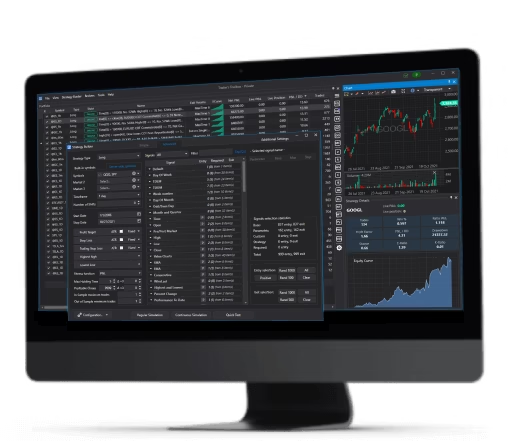
Build Alpha is designed to be 100% no-code. But you can extend it with custom Python signals that plug into that no-code workflow. In this hybrid approach:
| Python Handles | Build Alpha Handles |
|---|---|
| Custom indicators and proprietary signals | Combining signals into complete strategies |
| Alternative data transforms and filters | Large-scale genetic algorithm search |
| Feature engineering and research | Automated robustness testing (12+ tests) |
| Time-aligned signal output | Code export to Python, NinjaTrader, TradeStation, MT4/MT5, and more |
| Prototyping and experimentation | Live monitoring and portfolio construction |
The only requirement is that your Python signal outputs a time-aligned series that matches the market data. Once that signal is available, Build Alpha treats it like any other building block — combines it with other rules, optimizes its parameters, and tests it across markets and environments.
This allows traders to keep their proprietary logic in Python, avoid building and maintaining a full research and execution stack, apply consistent robustness testing across many candidates, and export validated strategies to their trading platform of choice. The result is a workflow where Python signals can be combined with Build Alpha’s 7,000+ built-in signals to discover trading strategies you would never find manually — then validated with the same anti-fragile testing process used across the entire platform.
For the step-by-step technical walkthrough — Custom Signal Editor, parameter placeholders, screenshots, and code export — see the full tutorial: Using Python in Build Alpha →
David Bergstrom
Founder, Build Alpha
David Bergstrom is the founder of Build Alpha. His background is in machine learning at a market-making firm. He has spent over a decade building systematic trading tools used by independent traders, proprietary firms, and hedge funds in 70+ countries.
Questions
Frequently Asked Questions
Can I use Python with Build Alpha?
Yes. Build Alpha is 100% no-code by default, but you can extend it with custom Python signals via the Custom Signal Editor. Your Python code becomes a building block that Build Alpha can combine, optimize, and validate like any other signal.
What format does a Python signal need to be in?
Your Python signal should output a time-aligned series that matches the market data — typically boolean (true/false) or numeric values — without dropping rows. This allows Build Alpha to treat it as a standard building block.
Why not just build everything in Python?
You can — but maintaining a full backtester, robustness testing suite, execution adapters, and live monitoring infrastructure is a significant engineering burden. The hybrid approach lets you keep Python for signal research and let Build Alpha handle the infrastructure at scale.
What robustness tests does Build Alpha run on Python signals?
The full suite — noise testing, walk-forward analysis, Monte Carlo simulation, vs random benchmarking, out-of-sample testing, and more. Python signals are treated identically to built-in signals for validation purposes.
Can Build Alpha export strategies back to Python?
Yes. Build Alpha exports fully executable code in Python (for Interactive Brokers), as well as NinjaTrader, TradeStation, MetaTrader 4/5, TradingView Pine Script, MultiCharts, and ProRealTime.
Do I need to know Python to use Build Alpha?
No. Build Alpha works entirely without code. Python is an optional extension for traders who already write custom signals and want to plug them into the no-code workflow. Almost half of Build Alpha users had no prior algorithmic trading experience.
Community
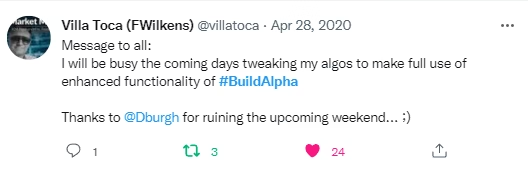
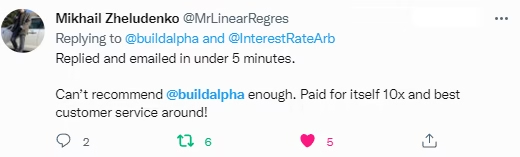
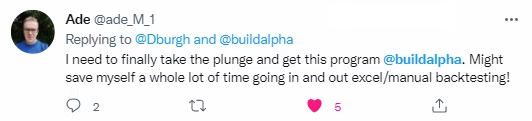
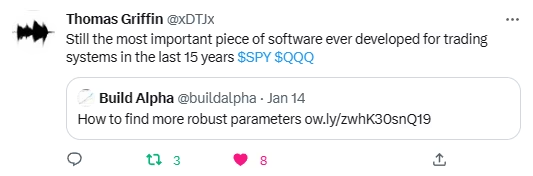
What Traders Say About Build Alpha












Related
Explore More
TutorialUsing Python in Build AlphaStep-by-step: Custom Signal Editor, parameters, and code export.HubRobustness Testing Guide12+ institutional-grade stress tests explained.HubAuto-Generated StrategiesThe complete strategy generation framework.GuideAlgorithmic Trading GuideThe complete guide for beginners and pros.
Break Your Strategies
Before the Market Does.
Write signals in Python. Let Build Alpha handle generation, validation, and deployment at scale.