What Biology Can Teach Us About
Robust Trading and Portfolio Fit
The next strategy doesn't need to be the best. It needs to be the best given what you already trade. Andreas Wagner's biology gives us the framework, and Build Alpha's Portfolio Search puts it to work.
Complete Guide Contents
Robustness & Research Series · Companion Reading
Most Trading Strategy Development Asks the Wrong Question
Most traders generate strategies the same way: review and rank by standalone metrics (Net profit, Sharpe, whatever).
But portfolios do not reward standalone beauty. They reward contribution.
The next strategy you add does not need to be the best strategy in isolation. It needs to be the best strategy given what you already trade. The one that earns when your existing book bleeds or the one that fills a regime your other strategies miss.
This is a different optimization problem and requires a different framework.
The Wagner Framework
A robust system is not just one that survives today. It is one that can still adapt when the environment changes tomorrow, and one that contributes something the rest of the ecosystem doesn't.
Evolutionary biologist Andreas Wagner gives us a surprisingly useful framework for this problem: robustness, evolvability, genotype networks, and the difference between systems that outcompete and systems that outcooperate.
His books Robustness and Evolvability in Living Systems and Arrival of the Fittest reframed how biologists think about how species both survive disruption and keep producing variation. The same vocabulary maps almost directly onto how a serious systematic traders operate.

This blog translates the biology into strategy (and portfolio) design and shows how Build Alpha's Portfolio-fit Generation feature puts it to work.
The Central Puzzle: Robust and Evolvable
Wagner's central question is: How can a system be robust enough to survive disruption and also flexible enough to keep evolving? On the surface these look contradictory. Robustness wants invariance. Evolvability wants change.
Trading has the same paradox. Let's see how biologists view this.
Genotype Networks: The 1-Mutant Neighborhood
Wagner's key technical contribution is the genotype network. Start with any genotype, any specific genetic configuration. Around it sits its 1-mutant neighborhood: every genotype that differs from it by exactly one mutation. Some of those neighbors produce the same phenotype (think result). Some produce something different. Some don't work at all.
In Wagner's framework, a genotype's robustness is literally defined as the fraction of its 1-mutant neighbors that preserve the phenotype. How many one-step-away versions still work?
The trading parallel is obvious. A robust strategy should not depend on one exact parameter setting. If RSI(14) works, RSI(13) and RSI(15) should still hold up. If a 2.0 ATR stop works, 1.9 and 2.1 should not collapse.


Good strategies live in neighborhoods (genotype networks), not isolated points. Similar settings often express the same underlying idea. If only one setting works, the strategy is fragile. If many nearby settings work (produce same phenotype), it is more robust.
✓ The Neighborhood Principle
Robustness is a property of the neighborhood, not the specific point. Two strategies with identical standalone backtests can have radically different genotype networks, and only one is robust!
The Trading Lens: Wagner in Build Alpha Language
Let's map a few key phrases from Wagner's biology to our trading universe. This will help us move into how we can solve these problems of fragile strategies and portfolios.
| Biology / Wagner Concept | Trading Equivalent |
|---|---|
| Genotype | Specific rule set, parameters, and filters |
| Phenotype | Observable strategy behavior (equity curve, trade profile) |
| 1-mutant neighborhood | All parameter configurations one tweak away |
| Genotype network | Set of strategy variants producing similar behavior |
| Neutral mutation | Parameter change that doesn't alter performance meaningfully |
| Fitness landscape | Performance surface across parameter and rule space |
| Robustness | Fraction of nearby parameter sets that still work |
| Modularity | Distinct strategy types capturing distinct market effects |
| Distributed redundancy | Multiple strategies covering each function with overlapping edges |
Neutral Mutations and the Parameter Plateau
Wagner emphasizes that neutral mutations, genetic changes that move you to a different genotype but produce the same phenotype, are not wasted. They let populations drift across the genotype network, quietly accumulating variation that becomes useful when the environment changes. A population that explores its neighborhood is preloaded with material for future adaptation. A population frozen on a single peak has nothing in reserve.
Trading has a direct (and under utilized) equivalent: the parameter plateau.
Diversify across parameters to increase robustness
A robust strategy should hold up across nearby parameter values. If RSI(14) works, RSI(13), RSI(15), or RSI(16) should not collapse.
Most traders use this only as a pass/fail robustness check, which is a good start. This is the Parameter Permutation test in Build Alpha. But if the neighborhood is stable, go further: instead of trading one “best” parameter set at full size, split the same allocation across several nearby versions.
These variants are not independent strategies. They are neutral mutations of the same idea. But each expresses the edge slightly differently, reducing dependence on one exact setting. This is the kind of future evolvability Wagner discusses.
The opposite is a fitness spike: one setting works and everything nearby fails. In this case, parameter diversification does not help because there is no neighborhood to diversify across and the single outperforming parameter set is likely to fail.
Ask yourself: does this setting live inside a stable neighborhood — and if so — should I trade the neighborhood instead of one point? Likely yes.
Modularity, Redundancy, and Portfolio Architecture
Wagner’s robustness is not only about neighborhoods. It is about how robustness is distributed across a system.
Biological systems are robust because they are modular. A cell is not one giant block of code. It is made of distinct parts: metabolic pathways, regulatory circuits, structural proteins, immune defenses, etc. with each performing a distinct function. Evolution can change one module without destroying the whole system.
But modularity is not enough. Important functions are often protected by distributed redundancy. No single gene carries the whole job. Instead, networks of genes partially overlap, so if one fails, others compensate.
Robust biology has both layers:
- separate modules for separate jobs
- overlapping components inside each module so no critical function depends on one fragile point
A robust trading portfolio looks the same.
Two Levels of Portfolio Robustness
Level 1: modularity between effects. Your portfolio should capture different market effects: trend, mean reversion, seasonality, breakouts, volatility events, carry, etc. Each is a distinct edge type that earns money in different conditions. When trend underperforms, mean reversion starts working. The portfolio is robust at this level because no single effect carries the whole book.
Level 2: redundancy within effects. Inside each effect you don't have one strategy. You have several. Each one sits on its own wide parameter plateau (or diversified across this width), or the effect is covered by multiple strategies with overlapping but distinct edges (think 15-min opening range breakout, 60-min opening range, London session opening range, high-vol opening range, etc.). The "trend effect" isn't carried by one trend strategy. It is carried by a network of trend strategies whose competencies partially overlap. When one degrades, the others are already partially doing its job.
What Fragile Portfolios Look Like
I have seen (maybe) thousands of portfolios over the years. A fragile portfolio fails at one or both levels.
Fails at Level 1. Every strategy is some flavor of the same effect. Each strategy may individually look robust, but the entire portfolio is one regime change from extinction.
Fails at Level 2. The book has multiple effects but each is carried by exactly one strategy. Looks diversified on paper. But every effect has a single point of failure: degrade the one trend strategy and the trend exposure goes to zero.
Fails at both. One market effect, one strategy, one parameter set. The 14-day RSI on SPY with no other holdings. Robust on a backtest, fragile in every other sense. Beginner level stuff. No shame - we all started here.
Robust at both. Many effects. Multiple strategies per effect. Each strategy on a wide plateau. The book absorbs failures at the strategy level, the effect level, and the regime level, because at every level there is something else doing the same (similar) job.
Outcompete vs. Outcooperate
Wagner doesn't write about "competing" or "cooperating" strategies. But the architecture he describes, modular and redundantly redundant, gives us a useful shorthand for thinking about what kind of contribution a new strategy makes to a portfolio.
Does a new startegy outcompete an existing one? Grounds for replacement. Does a new strategy outcooperate or fit a portfolio need? Grounds for addition.
Strategy generation should have one of the two goals (replacement or addition) in mind from the start.
Outcompete
The standalone winner
A strategy that wins on its own merits. Best Sharpe. Best Calmar. Cleanest drawdown profile as a standalone system. Traditional strategy generation is built entirely around this. It gives no insight into cooperation.
Outcooperate
The architectural fit
A strategy that fits into what you have. It fills a missing role/effect (Level 1 contribution) or it adds depth inside an existing effect (Level 2 contribution). Standalone metrics may be mediocre, but it does well when others bleed.
The Cooperation Insight
A strategy that outcooperates can be less individually fit than one that outcompetes and still be more valuable to the portfolio. A modest equity curve uncorrelated with your existing book is often worth more than an excellent equity curve riding the same waves you're already riding.
Most strategy generation answers the wrong question. It is not: "what's the best standalone strategy?" but "what's the best strategy given the architecture I already trade?".
Case Study: Outcompeter vs. Outcooperator
The goal is to improve this three strategy portfolio pictured below for this demonstration.

Consider two candidate strategies, both trading single assets on their own.


Strategy A trades Orange Juice futures based on weather signals available in Build Alpha. Strategy B trades Vix futures based on COT Report data available in Build Alpha. Strategy A was developed as a standalone strategy. Strategy B was built using the new Portfolio-fit Generation abilities (portfolio aware strategy generation).
Strategy A · Outcompeter
Standalone Beauty
Great backtest in isolation. But its correlation to the existing portfolio is high. Adding it barely changes the aggregate equity curve. You've essentially bought more of what you already own.
Strategy B · Outcooperator
Standalone Ugly
Less glamorous backtest. But its correlation to your existing book is slightly negative. Adding it meaningfully raises aggregate Sharpe and reduces aggregate drawdown, because it earns when your other strategies don't.
Looked at in isolation, Strategy A wins every comparison. Looked at in the context of your portfolio, Strategy B is the better addition by a wide margin.
A strategy may have this effect because it wins when the original portfolio does not. Or it simply trades when the original portfolio does not. A strategy that trades often may reduce available capital for the existing portfolio strategies. Long story short, this "phenomenon" is more common than you would think.


✓ The Case Study Lesson
Both strategies were built separately. Only one improved the portfolio. That is the difference between generation and portfolio-aware generation.
Portfolio-Fit Search: Ecosystem-Aware Strategy Generation
Build Alpha's Portfolio-fit Generation works with full awareness of your existing strategies. The fitness function becomes marginal portfolio contribution; that is, how much the candidate strategy actually improves the aggregate portfolio you already trade. Candidates compete for ecological gaps, not on individual metrics.
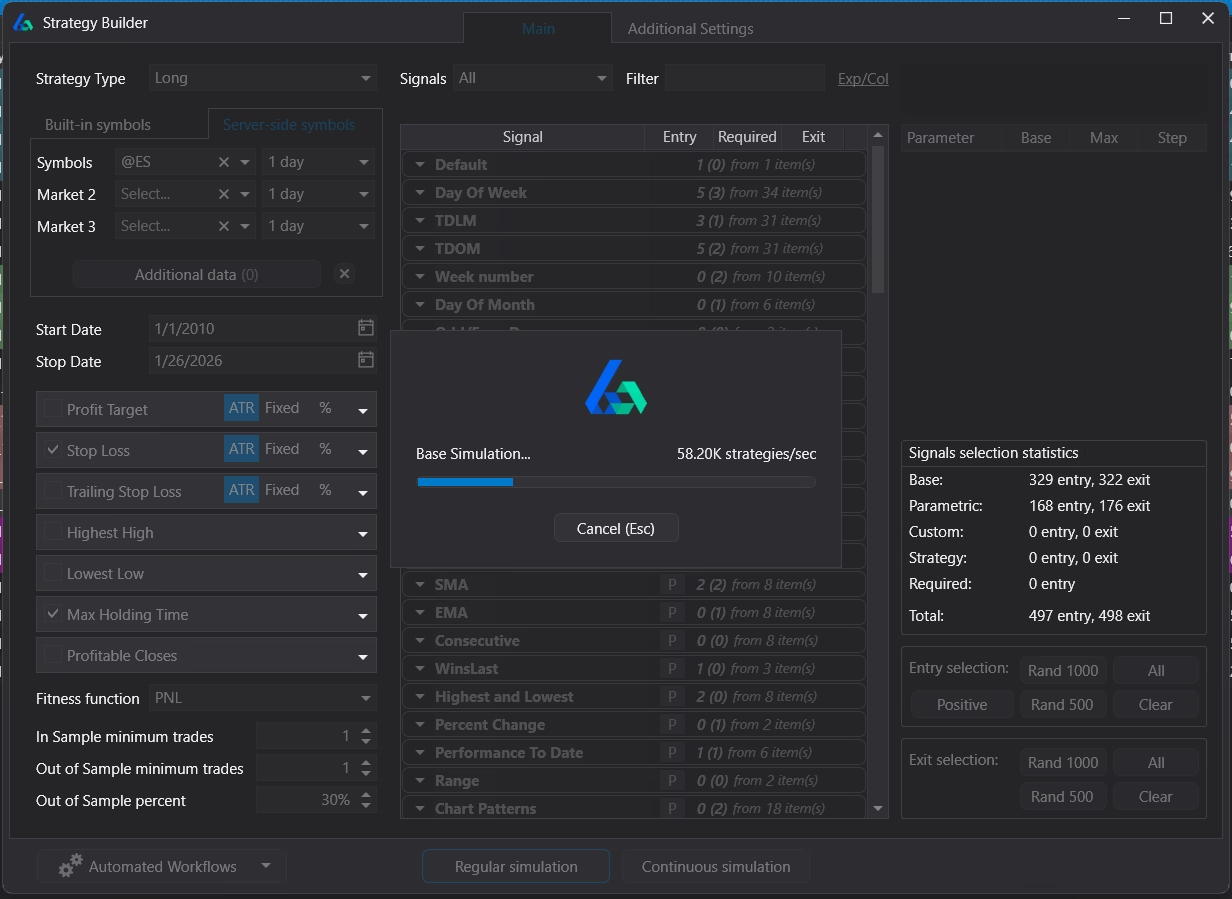
Step 1: Select Portfolio Search and choose your portfolio
Set strategy type to Portfolio Search. In the pop up editor, select which portfolio to find potential candidates for and modify any portfolio constraints. Build Alpha allows you to save multiple portfolios so this enables complete flexibility.

Step 2: Configure Build Alpha
Set entries, exits, position sizing, risk management as you would for any strategy generation. Please note that the fitness function is now the portfolio level marginal contribution instead of the individual strategy's fitness.
Step 3: Review Portfolio Lift
The Results Window includes a Portfolio Lift toggle near the upper right. Turn this ON to view each metric as the percentage improvement from adding the highlighted strategy to the original portfolio.
For example, a value of 21 trades means the portfolio traded 21% more than the original.

Right-click → Portfolio View to open the portfolio equity curve pictured above. Leave it open, click to highlight a different row and watch the portfolio view change. A fast way to view how different strategies impact your portfolio's equity curve.
This is what "outcooperate" looks like in practice. Build Alpha is no longer searching for the best individual organism but for the best addition to the ecosystem.
Portfolio Search Demo
The full workflow: from selecting a baseline portfolio to measuring Portfolio Lift. See why seemingly “ugly” standalone equity curves can become the best additions when they complement the existing basket and fill its performance gaps.
A Necessary Caution: Biology Is a Metaphor, Not Law
Wagner's work has received some scientific criticism, as all influential ideas do. More importantly for us: biology is a metaphor for markets, not a model of them. Living systems evolved over billions of years under selection pressures that don't directly apply to trading. Analogies help us think. They do not automatically generalize.
What's legitimate to take from Wagner
- The concept of neighborhood robustness: strategies should sit on plateaus, not spikes.
- The insight that robustness and evolvability coexist: good research pipelines produce both.
- Compete vs. cooperate: portfolios need ecological thinking, not just talent scouting.
What's not legitimate
- Treating parameter space as a true genome.
- Assuming diversification always works. Correlations rise or change in crises, and ecosystems can collapse. We are always taking risk.
⚠️ Use Wagner as a Philosophy
A way to think about the search process, the portfolio, and the trade-off between individual fitness and ecosystem fit. Not a substitute for hard validation. Nothing replaces robustness testing.
Takeaways
✓ Key Takeaways
- Robustness is a property of the neighborhood, not the point
- A research process needs robustness and evolvability
- Individual fitness and ecosystem fit are different things
- An outcooperator often beats an outcompeter in portfolio terms
- Portfolio-fit generation encodes this in the fitness function
💡 Need to Know
- Genotype networks translate directly to parameter plateaus
- Neutral mutations = parameter changes that don't hurt performance
- Correlation to existing book can outweigh standalone Sharpe
- Robustness tests still apply, portfolio fit is an added layer
- Biology is a metaphor, not a model. Validate everything
Summary
The Taguchi post showed how engineers would design individual strategies that survive noise. Wagner, the biologist, teaches us something complementary: how to design a research process that produces strategies which are both robust and diverse enough to strengthen the portfolio you already trade.
Build Alpha's portfolio-fit generation operationalizes this. Existing robustness tests handle the Taguchi side. Marginal contribution and correlation-adjusted fitness handle the Wagner side. Together they produce candidates that are not just individually strong, but ecologically useful. Don't just build strategies. Build ecosystems.

David Bergstrom
A decade-plus in professional trading as a market maker and quantitative strategy developer at a high-frequency trading firm with a CME seat. Consulting for hedge funds, CTAs, family offices, and RIAs. Self-taught C++, C#, and Python programmer specializing in data science, machine learning, and trading strategy development.
Frequently Asked Questions
Wagner's framework explains how biological systems can be both robust (resistant to disruption) and evolvable (capable of producing new adaptations). His central concept is the genotype network: many different genetic configurations produce the same observable trait, forming connected networks in gene space that preserve current function while keeping access to many different evolutionary futures. The same structure shows up in well-designed strategy populations.
"Outcompete" and "outcooperate" are framings I use to describe two ways a new strategy can contribute to a portfolio. Wagner doesn't use these terms. They are a shorthand for the architectural picture his work supports: modular systems with distributed redundancy. An outcompete strategy wins on standalone merits like best Sharpe, best Calmar, cleanest drawdown. An outcooperate strategy wins because of how it fits the portfolio you've already built. It either adds a market effect the portfolio doesn't currently capture, or adds depth within an existing effect with overlapping but distinct edges. A modest outcooperator often adds more portfolio value than a strong outcompeter that duplicates exposure(s) you already have.
Portfolio-fit generation modifies the genetic algorithm's fitness function to include marginal contribution to your existing portfolio. Candidates are scored on both standalone performance and how much they actually improve your aggregate book. Redundant edges are penalized. Survivors still pass the full robustness testing pipeline. Portfolio fit is a layer on top, not a replacement.
Standalone generation asks "what's the best strategy?" Portfolio-aware generation asks "what's the best strategy given what I already trade?" The first optimizes individual fitness. The second optimizes ecosystem fit. Mature portfolios need both modes, but most traders only use the first and end up over-exposed to a single way of making money.
A genotype network is the set of strategy variants (different parameters, filters, or rule combinations) that produce similar performance characteristics. A strategy sitting on a large genotype network has many nearby configurations that also work, meaning it is robust to small changes. A strategy alone on an island has no viable neighbors and is fragile to any perturbation. Build Alpha's Noise Test Parameter Optimization measures the size of this network directly.
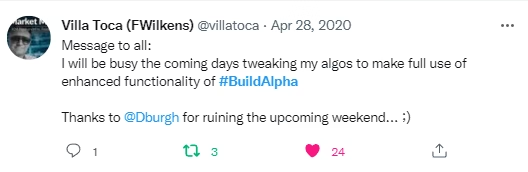
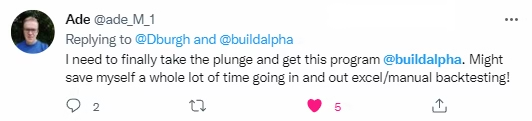
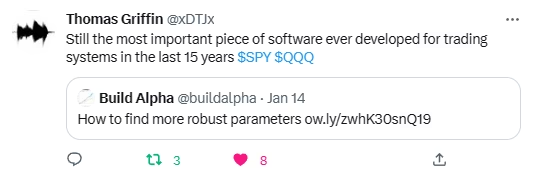
What Traders Say About Build Alpha













Explore More
Don't Just Build Strategies.
Build Ecosystems.
Portfolio-fit generation. 12+ robustness tests. No coding required.