
7,000+ Trading Signals.
Zero Coding Required.
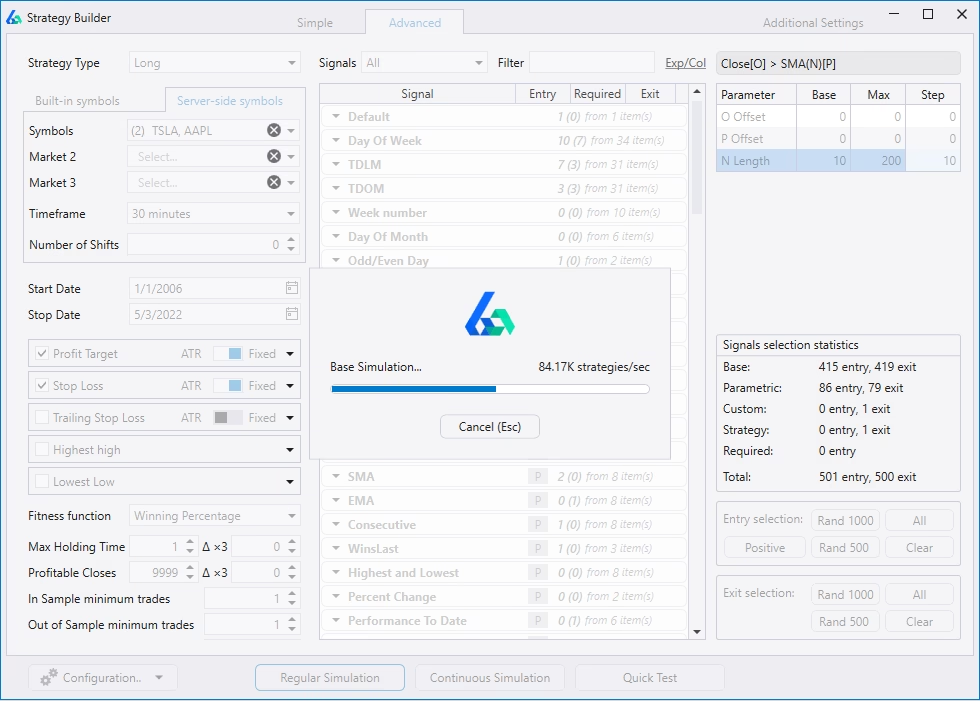
Technical indicators, alternative data, sentiment, COT, news events, weather, option flows — all point-and-click. Select 2 or all 7,000+ and let the genetic algorithm find what works.
7,000+
Signals
20+
Categories
0
Code Required
70+
Countries
Signal Deep Dives
Why Signals Matter More Than You Think
Most traders believe strategy development is about finding the right entry rule. In reality, it is about giving the algorithm enough diverse context so it can discover edges you would never find manually.
A strategy built on RSI alone may work in a mean-reverting market and fail in a trending one. Add market breadth, COT positioning, and volatility regime context — now the algorithm can learn when RSI works and when to stay flat.
This is why Build Alpha launched with 1,000 signals in its first version and now contains over 7,000+. Every new signal category gives the strategy generator more raw material to work with. More raw material means more diverse strategy candidates. More candidates means more survivors after robustness testing.
How It Works
Select any combination of signals — from 2 to all 7,000+. Hit simulate. The genetic algorithm searches millions of possible combinations of entries, exits, filters, and risk rules to find the best strategies. Then 12+ robustness tests filter out anything curve-fit. No coding at any step.
Price-Based vs Non-Price Signals
Build Alpha divides its signal library into two broad families. Understanding the difference is critical to building strategies that survive changing markets.
| Dimension | Price-Based Signals | Non-Price Signals |
|---|---|---|
| Data source | OHLC, volume, derived indicators | External data — breadth, COT, yields, news, sentiment |
| What they capture | What price is doing right now | What environment the market is in |
| Strength | Precise timing, pattern recognition | Regime awareness, context |
| Weakness | Blind to macro shifts and context | Lower precision on exact entries |
| Best use | Entry/exit timing | Filters and regime gates |
The Regime Problem
Price-only strategies are the most common source of lying backtests. They look great in the regime they were built for and collapse when conditions shift. Non-price signals provide the context needed to keep strategies aligned with the current environment — or to stay flat when conditions are unfavorable.
Price Action & OHLC Signals
📈
Price Action & OHLC Patterns
1,500+ SIGNALS
The foundation of most trading strategies. Build Alpha includes raw OHLC patterns, OHLC manipulations (square roots, cube roots, fourth roots), consecutive patterns, gap analysis, range analysis, highs/lows relative to N periods, and quantified chart patterns — all parameterized and ready to combine.
Open vs Close
Inside / Outside Bars
Gap Up / Gap Down
N-Bar Highs / Lows
Consecutive Up / Down
Range Expansion
OHLC Ratios
Quantified Chart Patterns
Breakouts
Square Root Transforms
Inside / Outside Bars
Gap Up / Gap Down
N-Bar Highs / Lows
Consecutive Up / Down
Range Expansion
OHLC Ratios
Quantified Chart Patterns
Breakouts
Square Root Transforms
Use case: Entry and exit timing. Combine with regime filters (volatility, breadth) for context-aware price action strategies.
🕯️
Candlestick Patterns
200+ SIGNALS
Every classic candlestick formation — quantified, parameterized, and testable. No subjective interpretation. Build Alpha detects each pattern automatically and lets you test whether it actually has statistical edge on your market and timeframe.
Doji
Hammer / Shooting Star
Engulfing
Morning / Evening Star
Harami
Three White Soldiers
Dark Cloud Cover
Spinning Top
Marubozu
Piercing Line
Hammer / Shooting Star
Engulfing
Morning / Evening Star
Harami
Three White Soldiers
Dark Cloud Cover
Spinning Top
Marubozu
Piercing Line
Use case: Short-term reversal and continuation detection. Stack with volume confirmation and volatility regime context.
Technical Indicators & Oscillators
📉
Full Technical Analysis Library
2,000+ SIGNALS
Every major technical indicator — parameterized with multiple variations per indicator. Moving average crosses, RSI levels, MACD divergence, Bollinger Band squeezes, Stochastics, Hurst exponent, Kaufman Efficiency Ratio, ADX, CCI, Williams %R, Keltner Channels, Donchian Channels, Ichimoku, and dozens more. Each indicator generates multiple signal variants (crossovers, thresholds, slopes, divergences) across configurable lookback periods.
SMA / EMA Crossovers
RSI
MACD
Bollinger Bands
Stochastics
ADX
CCI
Hurst Exponent
Kaufman Efficiency
Williams %R
Keltner Channels
Donchian Channels
Ichimoku
VWAP
Parabolic SAR
Rate of Change
RSI
MACD
Bollinger Bands
Stochastics
ADX
CCI
Hurst Exponent
Kaufman Efficiency
Williams %R
Keltner Channels
Donchian Channels
Ichimoku
VWAP
Parabolic SAR
Rate of Change
Use case: Trend identification, momentum measurement, mean reversion timing, and overbought/oversold detection across any timeframe.
Volume & Liquidity Signals
📊
Volume Analysis
300+ SIGNALS
Volume confirms or denies price moves. Build Alpha includes relative volume, volume spikes, volume-weighted indicators, on-balance volume, accumulation/distribution, money flow, volume-at-price derivatives, and volume regime classification. Volume context is often the missing ingredient that separates real breakouts from false ones.
Relative Volume
Volume Spike
On-Balance Volume
Accumulation / Distribution
Money Flow Index
VWAP Deviation
Volume Rate of Change
Climax Volume
Volume Spike
On-Balance Volume
Accumulation / Distribution
Money Flow Index
VWAP Deviation
Volume Rate of Change
Climax Volume
Use case: Breakout confirmation, exhaustion detection, and institutional activity identification.
Volatility & Regime Signals
🌊
Volatility, VIX & Regime Classification
500+ SIGNALS
Volatility is the single most important context variable in trading. Build Alpha includes ATR-based signals, synthetic VIX, VIX futures term structure (contango, backwardation, roll yield), volatility regime classifiers, ATR breakouts, Bollinger Band width, and realized volatility measures. These tell you whether you are trading in a calm or chaotic environment — and whether to use trend or mean-reversion strategies.
Average True Range
Synthetic VIX
VIX Term Structure
VIX Contango / Backwardation
Volatility Regime
ATR Breakouts
Historical Vol Ratio
Bollinger Width
Annualized Vol
Synthetic VIX
VIX Term Structure
VIX Contango / Backwardation
Volatility Regime
ATR Breakouts
Historical Vol Ratio
Bollinger Width
Annualized Vol
Use case: Regime gates and strategy switching. Use VIX term structure to filter entries during unfavorable volatility conditions. Essential for building anti-fragile portfolios.
Market Breadth Signals
🏛️
Stock Market Breadth
400+ SIGNALS
Breadth measures whether the broad market confirms or diverges from index-level price action. Build Alpha includes advance-decline ratios, new highs vs new lows, percentage above moving averages, McClellan Oscillator, breadth thrust indicators, 52 week highs and lows, and cumulative breadth lines. Breadth divergences are among the most reliable warning signals for regime changes.
Advance / Decline Ratio
New Highs vs New Lows
% Above 200 SMA
% Above 50 SMA
McClellan Oscillator
Breadth Thrust
52 Week Highs and Lows
% of stocks higher
Up Volume Ratio
New Highs vs New Lows
% Above 200 SMA
% Above 50 SMA
McClellan Oscillator
Breadth Thrust
52 Week Highs and Lows
% of stocks higher
Up Volume Ratio
Use case: Confirm or reject index-level signals. Detect hidden weakness beneath bullish headlines. Essential for equity index strategies.
Treasury Yields, Spreads & Economic Data
🏦
Macro & Economic Signals
500+ SIGNALS
Interest rates and economic data drive long-term market direction. Build Alpha includes treasury yield levels and slopes (1MO, 3MO, 6MO, 1Y, 2Y, 5Y, 10Y, 30Y), yield curve inversions, credit spreads, economic surprise indices, CPI/PPI/employment data releases, Fed funds rate expectations, and the full economic calendar. These signals are critical for building strategies that adapt to changing monetary and economic environments.
Treasury Yields (1MO–30Y)
Yield Curve Slope
Yield Curve Inversion
Credit Spreads
CPI and Inflation data
CPI / PPI Releases
Employment Data
Fed Funds Expectations
PMI
Yield Curve Slope
Yield Curve Inversion
Credit Spreads
CPI and Inflation data
CPI / PPI Releases
Employment Data
Fed Funds Expectations
PMI
Use case: Macro regime classification. Yield curve signals help determine risk-on vs risk-off positioning. Economic data events create short-term volatility that can be exploited or avoided.
Commitment of Traders (COT) Data
📋
CFTC Commitment of Traders Report
300+ SIGNALS
The CFTC’s weekly report reveals how commercial hedgers, large speculators, and small traders are positioned in futures markets. Build Alpha incorporates net positions, position changes, extremes, concentration ratios, and commercials-vs-speculators divergences across every major futures contract. Commercial positioning is one of the best long-term contrarian signals available — when the “smart money” hedgers reach extreme positions, reversals often follow.
Commercial Net Position
Large Speculator Net
Small Trader Net
Position Change (Week)
Extreme Readings
Concentration Ratio
Commercials vs Specs
Open Interest Change
Large Speculator Net
Small Trader Net
Position Change (Week)
Extreme Readings
Concentration Ratio
Commercials vs Specs
Open Interest Change
Use case: Swing and position trading in futures and forex. COT extremes identify potential trend reversals weeks before they appear in price action.
Sentiment & Option Flow Signals
🧠
Market Sentiment, Options & Dark Pools
400+ SIGNALS
What are other market participants doing? Build Alpha includes sentiment survey readings from both AAII and NAAIM, gamma exposure (GEX), options flow imbalances, dark pool index (DIX), fear/greed composites, and Google Search Trends data. Sentiment data captures the emotional state of the market — and extreme sentiment often precedes turning points.
AAII Survey
NAAIM Survey
Gamma Exposure (GEX)
Options Flow
Dark Pool Index (DIX)
Sentiment Surveys
Fear / Greed Index
Google Search Trends
NAAIM Survey
Gamma Exposure (GEX)
Options Flow
Dark Pool Index (DIX)
Sentiment Surveys
Fear / Greed Index
Google Search Trends
Use case: Contrarian signals at extremes. GEX levels identify mechanical support/resistance from options market makers. Dark pool data reveals institutional conviction.
News Events, Holidays & Seasonality
📰
News, Calendar & Seasonal Patterns
300+ SIGNALS
Markets behave differently around scheduled events. Build Alpha includes FOMC meetings, NFP releases, CPI days, earnings seasons, options expiration, holidays, day-of-week patterns, month-of-year patterns, turn-of-month, end-of-quarter, and full seasonal decomposition. You can test whether to trade into, around, or away from specific calendar events — and quantify the edge rather than guessing.
FOMC Meeting Days
Non-Farm Payrolls
CPI Release Days
Options Expiration
Holidays
Day of Week
Month of Year
Turn of Month
End of Quarter
Earnings Season
Non-Farm Payrolls
CPI Release Days
Options Expiration
Holidays
Day of Week
Month of Year
Turn of Month
End of Quarter
Earnings Season
Use case: Calendar-based filters and event-driven strategies. Some of the most durable edges in markets are simple seasonal patterns that persist because they are driven by structural fund flows.
Alternative Data: Weather, Intermarket & More
🌦️
Weather, Intermarket & Alternative Data
400+ SIGNALS
Edges often hide where other traders aren’t looking. Build Alpha includes weather data for agricultural and energy markets, intermarket signals (how one market influences another), multi-timeframe signals (daily signal used on intraday chart), cross-asset correlations, currency pair relationships, and the ability to import any custom alternative dataset via CSV.
Temperature Data
Precipitation Data
Heating / Cooling Degree Days
Intermarket Signals
Multi-Timeframe
Cross-Asset Correlation
Currency Pair Relations
Custom CSV Import
Precipitation Data
Heating / Cooling Degree Days
Intermarket Signals
Multi-Timeframe
Cross-Asset Correlation
Currency Pair Relations
Custom CSV Import
Use case: Commodity and energy strategies with weather context. Multi-timeframe signals for aligning intraday entries with daily trends. Any data source you can export to CSV becomes a Build Alpha signal.
Custom Signals: Drag-and-Drop & Python
🛠️
Custom Signal Builder & Python Integration
Unlimited
When 7,000+ signals aren’t enough, build your own. The drag-and-drop Custom Signal Builder lets you combine any data fields into new formulas with no code. For advanced users, Build Alpha accepts Python indicator files using the GetCustomSignal template — write any indicator in Python and Build Alpha treats it like a native signal. You can also import external data as a custom column via CSV or TXT.
Drag-and-Drop Builder
Python GetCustomSignal
CSV/TXT Import
Custom Formulas
Machine Learning Classifiers
Any External Data
Python GetCustomSignal
CSV/TXT Import
Custom Formulas
Machine Learning Classifiers
Any External Data
Use case: Proprietary research. Test your own hypotheses without being limited by a fixed signal library. Import alternative datasets, sentiment APIs, or ML model outputs and let Build Alpha’s robustness tests validate them.
Machine Learning & Advanced Signals
Build Alpha includes the ability to incorporate machine learning classifiers and ensemble methods as signal types — not black boxes, but transparent building blocks. These include decision tree outputs, nearest-neighbor classifications, and clustering-based regime detectors. Each ML signal can be generated on in-sample data and validated through the same 12+ robustness tests as any other signal. This can help avoid the common trap of overfitting ML models to historical data without proper out-of-sample validation.
Signals Alone Are Not Enough
Having 7,000+ signals is meaningless without proper validation. Any signal library will produce strategies with beautiful backtests — most of which are lying.
This is why Build Alpha pairs its signal library with the industry’s most comprehensive robustness testing suite: noise testing, Monte Carlo simulation, walk-forward analysis, Vs Random benchmarking, variance testing, delayed entry testing, parameter stability analysis, and more. The signals generate candidates. The robustness tests decide which candidates survive.
The Build Alpha Pipeline
Select signals → Generate strategies → Filter with 12+ robustness tests → Export code to your platform. The signal library is the input. Robustness testing is the filter. The exported strategy is the output. All no-code, all point-and-click.
Takeaways
✓ Key Takeaways
- 7,000+ signals across 20+ categories — all point-and-click
- Non-price signals provide the market context that price-only strategies lack
- More signal diversity means more candidate strategies that survive robustness testing
- Custom signals via drag-and-drop, Python, or CSV import — no limits
- Signals are the input. Robustness testing is the filter. Both matter equally.
💡 Key Resources
- Market Breadth — why breadth divergences predict regime changes
- COT Report — commercial hedger positioning as a contrarian signal
- News Events — calendar-based trading and event-driven edges
- Weather Data — alternative data for commodity and energy strategies
- Robustness Testing — the 12+ tests that validate every strategy

David Bergstrom
Founder, Build Alpha
A decade-plus in professional trading as a market maker and quantitative strategy developer at a high-frequency trading firm with a CME seat. Consulting for hedge funds, CTAs, family offices, and RIAs. Self-taught C++, C#, and Python programmer specializing in data science, machine learning, and trading strategy development.
Questions
Frequently Asked Questions
What signals are available in Build Alpha?
Build Alpha includes 7,000+ signals across 20+ categories: technical indicators, price action, candlestick patterns, volume, volatility, moving averages, momentum oscillators, market breadth, COT data, treasury yields and spreads, economic data, news events, sentiment, option flows, gamma exposure, dark pool activity, weather data, seasonality, intermarket signals, multi-timeframe signals, machine learning classifiers, and fundamentals. Users can also build custom signals with a drag-and-drop builder or import Python indicators.
Do I need to code to use Build Alpha’s signals?
No. Every signal in Build Alpha is point-and-click. Select any combination, hit simulate, and the genetic algorithm searches millions of combinations. No programming experience is required. For advanced users, you can also add custom indicators using Python.
What is the difference between price-based and non-price-based signals?
Price-based signals are derived from OHLC data — moving averages, RSI, Bollinger Bands, candlestick patterns, breakouts. Non-price-based signals use external data — market breadth, COT reports, treasury yields, VIX term structure, news events, option flows, sentiment, and weather. Non-price signals provide market context that helps strategies stay aligned with current conditions.
Can I add my own custom indicators to Build Alpha?
Yes. Build Alpha supports custom signals in three ways: a drag-and-drop custom signal builder requiring no coding, Python indicator files using the GetCustomSignal template, and CSV/TXT data imports for any external data source.
Why do non-price signals matter for algorithmic trading?
Price-only strategies often fail when market conditions change because they lack context. Non-price signals like market breadth, COT positioning, VIX term structure, and treasury spreads tell you what environment you are trading in — bull or bear, risk-on or risk-off, trending or choppy. This context helps strategies adapt to regime changes instead of breaking down.
What alternative data does Build Alpha support?
Build Alpha supports alternative data including weather data for commodity and energy trading, dark pool activity indices, gamma exposure and options flow data, news event calendars, economic surprise indices, sentiment indicators, and the ability to import any custom alternative dataset via CSV.
Community
What Traders Say About Build Alpha













Related
Explore More
GuideRobustness Testing12+ tests to validate strategies before risking capital.GeneratorStrategy Generator SoftwareHow Build Alpha generates and validates strategies.Case StudyLying BacktestsTwo strategies, one truth — see which survives.AdvancedAnti-Fragile SystemsBuild portfolios that benefit from disorder.SignalsMarket BreadthWhy breadth divergences predict regime changes.SignalsCOT ReportCommercial positioning as a contrarian signal.SignalsNews Event TradingCalendar-based edges and event-driven strategies.Alt DataWeather Data TradingAlternative data for commodities and energy.
7,000+ Signals.
Zero Coding Required.
Select. Simulate. Validate. Export. All point-and-click.