Intraday Trading
What is Intraday Trading?
Intraday trading is a form of speculation that opens and closes a position within the same trading session or within the same day. All positions are generally closed before the close of the day and the trader assumes no overnight risk. Intraday trading is often referred to as day trading.
Intraday Data
Intraday data is any timeframe less than daily. Any minute bars or custom bar types such as range, Renko, Kase, volume, tick, or dollar can be considered intraday data.
The most popular intraday timeframes are
- 5-minute
- 15-minute
- 30-minute
- 60-minute
For example, the 15-minute timeframe creates a new bar every 15 minutes. That is, each 15-minute period will have its own open, high, low, close and cumulative volume. Here is an example below. Notice the first bar contains data from the 9:30 open through the first 15-minute period ending at 9:45 AM.

How much Intraday data is needed?
More is better. To create reliable and robust trading strategies, a trader must have sufficient intraday data. The amount of data is less important than the number of trades. I have spoken extensively about sample size, the law of large numbers, and reliability here
In short, we need enough trades (from different market environments) to have confidence our trading strategy is robust. If you acquire data from a bull market, then that is probably not enough. If your data covers a bull and bear market, then you are in better shape.
Where to get Intraday data?
How to set Intraday timeframes with Build Alpha
Build Alpha now offers intraday strategy testing and data – making it a full one stop shop intraday algorithmic trading platform. Tab over to the server-side data symbols and set the timeframe from the dropdown. Build Alpha will then calculate all the selected entry and exit signals on the desired timeframe prior to strategy generation.

Intraday Specific Features
Build Alpha has features specifically geared toward intraday traders. Below I break down each of them
Time Windows
Set specific time windows or trading hours that strategies are permitted to trade. Exclude trading during quiet lunch hours or during pre and post market stock market hours. Search for the Time Signal category and set acceptable hours. You can change the values (‘V’) to a specific time or you can set a range of times.

Other than specific trading hours, there are other intraday trading indicators in Build Alpha for day traders like volume weighted average price (VWAP), pre and post market signals, and more.
Force End of Day Exit
Avoid taking overnight risk by forcing Build Alpha to exit all open positions in every strategy it creates at your specified End of Day time. This End of Day time can be the market close or it can be midday, it is completely up to the trader.

Overnight risk is often overblown by beginner traders. I debunk this trading “truth” as my third point here
Intraday Checks
The basics of intraday trading are that everything must be confined to a single day and restarts the next day. Each day begins a clean slate. Finding filters on how each day should go or when it should end can do wonders for the trading account.
Build Alpha traders can take any intraday trading strategy and run it through the Intraday Checks test to find hidden edges. Intraday Checks will test for
- Maximum P&L per day
- Minimum P&L per day
- Optimal Start Time
- Optimal End Time
- Optimal Number of Trades per day

The trader can click on any strategy to highlight and view the rules from the optimization process. Upon exit, the trader can add any of these rules to the generated code with no programming in order to live trade the strategy.
To read more
Intraday Edge
Intraday trading is all about making our capital more efficient. The Intraday Edge feature takes a daily trading strategy and attempts to see if most of the profits can be attributed to a smaller time window. In other words, do we need to hold the daily strategy for the entire day or can we achieve most of the return by holding for a shorter period?
Since daily data has less noise, it is often easier to find daily strategies. However, Intraday Edge attempts to find intraday trading strategies from daily trading strategies. I call this finding intraday strategies backwards.
I wrote about an example in this blog that found that about 80% of the trading strategies profits could be attributed to a two-hour window. Holding for two hours is much better than holding for 24.
Multi-timeframe Trading
Traders can also set Market2 and Market3 to higher timeframes and require confirmation from multiple timeframes.
Additionally, you can create signals that only trade when the current (intraday) price is inside the previous daily range or only trade when current (intraday) price is above the previous daily high, for example. Assuming you set Market2 to daily timeframe then this would only trade when price is above previous day's high.

Quick Test – Stocks for Intraday Trading
The Quick Test feature analyzes the specifics of a strategy to learn more about it. This can be a benefit for both manual traders and systematic traders.
Learn what time
- Stops Losses are hit
- Profit Targets are hit
- Pre-market High is breached
- Pre-market Low is breached
- Make the high of the day
- Make the low of the day
Quick Test also returns a summary of the best and worst performing stocks as well as total summary across all symbols included in the test.

Intraday Trading Strategies
Time of Day and News Events
One of the most popular techniques is to combine time windows and news events. This can restrict trading to a time window before, during, or after an economic release. News tends to move the markets and certain windows of time around these events exhibit capturable market volatility.
To test this in Build Alpha, simply select and require a time window and news event.
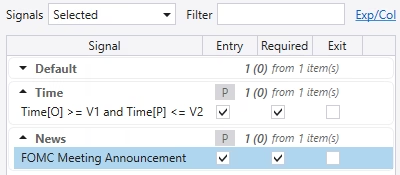
Here is a quick example showing how SPY has performed ahead of a Federal Reserve Interest Rate decisions if the close in the half-hour before the release was in the top 75% of the bar. This example holds the trade for 90 minutes. These results were achieved with three signals
- Strong Close (IBR >= 75%)
- Fed Meeting Announcement
- Time is 13:30:00 or 1:30 PM

Finding other filters or adding technical analysis may be an avenue to improve this concept.
Read more
Time Windows tend to be robust
Humans are creatures of habit. The market is a collection of human decisions. Therefore, there should be patterns of habit in the data. Looking for time windows or time anomalies is one of the simplest, and often, most robust ways to discover intraday trading edges. I share two simple ones in this blog post from 2017 Free Friday Strategy 20.
- Long S&P500 at 2 AM
- Short EURUSD at 5 AM late in the week

If you find other ones, please feel free to comment them here.
Intraday Pros
Capital Efficiency
Buying and selling in short price movements can increase the rate at which capital compounds. An intraday trader can reach significant sample size or the law of large numbers much quicker.
Time in Market
Shock risks such as an air strike, riot at the capital, terrorist attack, flash crash or whatever the next Black Swan may be, are rarely beneficial for trading positions. Reducing your time in the market decreases the odds that the next one will impact your trading account.
Psychology
Going home flat with no market risk at the end of the trading day can be a big advantage for the day trader. The ability to square off your position and being able to unplug to spend time with family or friends can help short-term decision making and overall quality of life.
On the other hand, going home flat eliminates the possibility of waking up to fat gains – which also has its own psychological merits.
Intraday Cons
Noisy Data
Intraday data is riddled with random price fluctuations and meaningless movement that makes it harder to detect true buy and sell signals and significant price anomalies. Higher timeframe data is often “better behaved”.
Competing against the best
I cannot describe the skill and intellect difference between professional market makers, high frequency traders, and prop traders compared to the average retail trader attempting to catch breakouts on a 5-minute chart.
For the retail trader, I equate this to walking into a Vegas poker room and seeing a table of poker professionals at one table and seeing a table full of drunk tourists at another. Scalping strategies put you at the table full of pros. Can you make money here? Maybe. Is it easy? F No.
Choose your table wisely.
Smaller margin of error
The average profit per trade is much smaller on lower timeframes. This leaves less room for error or normal market behavior. Slippage, commissions, bad fills, late entries or exits, etc. are inevitable and erode trading profits. The smaller your average profit per trade, the harder to overcome these inevitabilities.
Pattern Day Trader
US Stock Traders are limited to 4 round trip trades in a rolling 5-day period in margin accounts. A trader can run out of “ammo” before an opportunity strikes. Futures and other asset classes are not subjected to this rule. To learn more here is a good link: Pattern Day Trader.
Summary
Intraday trading or day trading is buying and selling the same position in the same trading day. Intraday trading requires lower timeframe data and does not hold any positions when the market closes. Intraday trading can be applied to any asset class such as stocks, mutual funds, ETFs, futures, forex, and cryptocurrencies. Build Alpha has unique features geared towards finding, optimizing, and analyzing intraday trading strategies. Build Alpha aims to be the best intraday algorithmic trading software available to all traders.
Author

David Bergstrom – the guy behind Build Alpha. I have spent a decade-plus in the professional trading world working as a market maker and quantitative strategy developer at a high frequency trading firm with a Chicago Mercantile Exchange (CME) seat, consulting for Hedge Funds, Commodity Trading Advisors (CTAs), Family Offices and Registered Investment Advisors (RIAs). I am a self-taught programmer utilizing C++, C# and python with a statistics background specializing in data science, machine learning and trading strategy development. I have been featured on Chatwithtraders.com, Bettersystemtrader.com, Desiretotrade.com, Quantocracy, Traderlife.com, Seeitmarket.com, Benzinga, TradeStation, NinjaTrader and more. Most of my experience has led me to a series of repeatable processes to find, create, test and implement algorithmic trading ideas in a robust manner. Build Alpha is the culmination of this process from start to finish. Please reach out to me directly at any time.