S&P 500 futures are a financial futures contract that reflect the expectations of the future value of the S&P 500 cash index which is based on the cash price of stocks being traded within the benchmark index. The S&P500 futures contract allows traders and investors to hedge or speculate on the future value of the S&P500 market index. The 500 stocks in the S&P 500 are 500 large companies intended to be a good representation of the U.S. economy.
What is the S&P 500?
The S&P 500 is a market-capitalization-weighted index of 500 large publicly traded companies intended to be a good representation of the overall stock market, and by extension the U.S. economy. This is similar to the Dow Jones which tracks only 30 companies.
The SP500 index was introduced in 1957 to track the value of 500 large-cap corporations that have their stocks listed on the New York Stock Exchange (NYSE) and the Nasdaq to serve as a benchmark of equity market performance.
You cannot directly invest in the S&P 500 because it is an index, but you can invest in many funds that use the S&P 500 index as a benchmark or in futures contracts.
Who is S&P?
S&P stands for Standard and Poor’s, which is an American credit rating agency founded in 1860 and is based out of New York. Standard and Poor’s publishes financial research and analysis on stocks, bonds and commodities. S&P is also considered the largest of the Big Three credit-rating agencies which includes Moody’s Investors Service and Fitch Ratings. Since 2016, Standard and Poor’s goes by S&P Global Ratings and currently employs over 10,000.
What is a Futures Contract?
A futures contract is a financial legal agreement to buy or sell a particular commodity, asset, or security at a predetermined price at a specified time in the future. The predetermined price is known as the forward price and the specified time when delivery and payment occur is known as the delivery date.
How does a futures contract work?
Futures contracts involve both a buyer and sell that agree to transact at a set price at a set date. Futures contracts are traded on futures exchanges and require a brokerage account that is approved to trade futures.
Unlike options, which can become worthless at expiration, futures contracts must be “delivered” from the seller to the buyer at contract expiration, the previously mentioned set date. The S&P 500 futures contract is cash settled meaning the delivery is cash but other commodities like oil or corn have physical delivery of actual asset.
What is margin?
Margin or Initial Margin is the amount of money needed to open a new position on a futures contract. The margin value is set by the exchange the futures contract is listed. Said another way, Initial Margin is a percentage of the total market value of the security purchased that must be paid in cash by the investor.
S&P 500 Margin
The S&P 500 margin is currently $5,060 but you can see updated values here: E-mini S&P 500 Futures Margins – CME Group. This is the amount needed to control one E-Mini S&P 500 Futures contract. Later we will discuss the different types of S&P 500 futures available.
What is a tick value?
The tick value is the dollar amount that each price fluctuation results in per contract.
S&P 500 Tick Value
The S&P 500 minimum tick movement is 0.25 points and each 0.25 point move results in a $12.50 change in contract value. That is, a price movement from 3,833.00 to 3,833.25 would result in a net gain of $12.50 per contract. Traders cannot trade at prices smaller than 0.25 increments.
What is expiration?
Expiration is the set date the contract expires, and the seller must deliver the agreed upon asset to the buyer at the predetermined price. After expiration, a new contract of the next expiration date will receive most of the trading volumes. Rollover is the trading term to describe trader volume moving from one contract expiration to the next expiration.
When is S&P 500 futures expiration?
Sp500 futures expire quarterly in March, June, September, and December on the third Friday of the month. Trading terminates at 9:30 a.m. ET on the third Friday of the contract month.
SP500 futures expiration is so impactful that during expiration there can be increases in volatility and trading activity known as Quadruple Witching Day or Triple Witching Day.
What is a futures contract symbol?
A futures symbol has three components: the root, the contract expiration month’s code, and the expiration year. For instance, a symbol ESM23 can be broken down into
- ES – symbol root for E-Mini S&P 500
- M – contract code for June expiration
- 23 – expires in year 2023
March’s contract expiration code is H. June’s is M, September’s is U, and December’s is Z.
What are futures trading hours?
Futures trade nearly 24 hours per day and 5 days per week. Futures trade even when the U.S. stock market is closed and often provide an indication of next session’s stock market trading activity. However, each futures contract has its own specific trading hours set by the listing exchange.
What are the S&P 500 Futures Trading Hours?
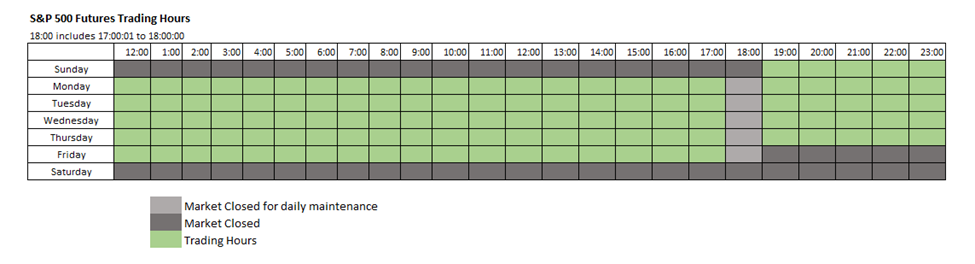
S&P500 futures trade from Sunday at 6:00 P.M. ET to Friday at 5:00 P.M. ET with a one hour break each day for daily maintenance between 5:00 P.M. and 6:00 P.M.
What are the different S&P 500 futures?
There are three different S&P 500 futures contracts each with different contract specifications for margin and tick value. Below I will do my best to summarize each
- SP500 Standard or “Big” contract
- SP500 Emini Futures Contract
- SP500 Micro Futures Contract
SPX Futures or the Standard “Big” contract
The original SP500 futures contract was introduced by the Chicago Mercantile Exchange (CME) in 1982 with the symbol root SP and had a point value of $250 per S&P point. That is, each point move would result in a $250 change to an open position per contract. The big SP contract had a minimum tick fluctuation of 0.25 index points resulting in a $62.50 change in open positions.
Due to the large size, this contract was mostly traded by institutions and commercial trade managers in an open outcry auction system at the CME trading pits. However, trading in this futures contract ceased in September 2021.
Emini Futures or ES futures
The most popular SP500 futures contract is known as the Emini and is 1/5 the size of the “big” contract with a point value of $50. The CME added the e-mini contract with the symbol root ES in September of 1997 due to demand for a smaller futures contract from active independent traders.
Today, the Emini is the most traded stock index future contract and has a minimum tick fluctuation of 0.25 points resulting in a minimum tick value of $12.50 per contract.
A trader opening a position at 3840.25 and selling at 3840.75 would net two ticks or $25 per contract on the trade (sans trading commissions). Margin is typically around $5,000 per contract meaning that one contract controls $5,000 * $50 or $250,000 in notional value. This large leverage, controlling $250,000 for a mere $5,000, is part of futures trading’s attractiveness.
Micro S&P Futures
The Micro S&P 500 futures contract is 1/10th the size of the Emini and 1/25th the size of the Big SP 500 futures contract; that is, the micro has a point value of $5. The minimum tick fluctuation is still 0.25 index points or $1.25 per one tick.
The CME added the micro contract in 2019 using the symbol root MES. The micro and mini share the same trading hours and give traders with smaller accounts additionally flexibility.
Micro E-Mini S&P 500 Specifications

Why trade S&P 500 Futures
Liquidity
According to the Chicago Mercantile Exchange, the S&P 500 index serves as a benchmark for $5 trillion in assets which results in large trading volumes in the SP500 futures contracts. A typical trading day in the SP500 emini futures results in 1,000,000-plus contracts being traded with decent order book depth which means traders can often get fills at their desired price without having to play games.
Leverage
Futures enable traders to control more dollars than they have. This can result in greater returns on invested capital but of course leverage cuts both ways on the downside. The ability to initiate a trade for $5,000 in order to control $250,000 worth of assets can help grow (or decimate) a small account.
Trading Hours
The 23-hour session provides more opportunities to find tradeable patterns. The extended globex trading session also gives traders and money managers the ability to act quickly on overnight news, hedge portfolio exposure, and change their mind before the stock market reopens. This can provide peace of mind to equity investors.
Tax Benefits
For US citizens, futures contracts offer tax advantages compared to trading stocks and ETFs. All gains on futures are taxed using a 60/40 rule. The first 60% of your futures gains are taxed at the long-term capital gains rate (approx. 15%) despite holding time and the remaining 40% of gains are taxed at your ordinary income rate.
The Internal Revenue Code section 1256 will provide a better explanation. And as always, consult your tax accountant or financial advisor as I am not either.
Short Selling (no borrows)
Futures contracts are always available to sell short unlike stocks and ETFs. There is no need to locate borrows, understand borrow fees, etc. as one can simply initiate a long or short trade using futures with the initial margin requirement.
No Pattern Day Trader Restrictions
Stock traders with less than $25,000 accounts are limited to only four round trip (day trades) trades in a rolling 5-day period otherwise will have restricted account privileges and marked a pattern day trader. The PDT rule does NOT apply to the futures market.
Years ago I have published a handful of strategies to demonstrate some well-known index futures trading strategies on real market data.
Overnight Gains
Did you know the S&P 500’s overnight session has outgained the US trading session’s returns by about 3 to 1? To capture this overnight phenomenon as a trading system, one can (in theory) buy the close and sell the next open. The US session would be captured by buying the opening and selling the same day’s close.
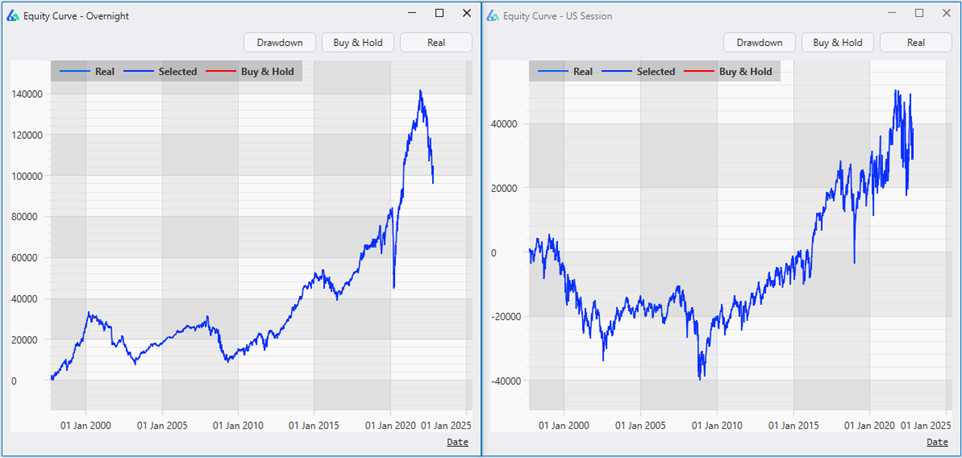
Above is a side-by-side comparison of the overnight gains (left) vs US session gains (right). Note in this example, I used the futures data from 9:30 a.m. ET to 4:00 p.m. ET as the US session.
The Early Bird
The S&P 500 futures seem to catch a bid from about 2:00 A.M. ET to 3:00 A.M ET and have for the past twenty years. I am sure publishing content around this phenomenon will help erode it, but I originally wrote about this trading strategy back in 2017 here: Build Alpha Intraday Strategy Examples and both strategies have continued to make new all-time highs nearly six years later.
Turnaround Tuesday
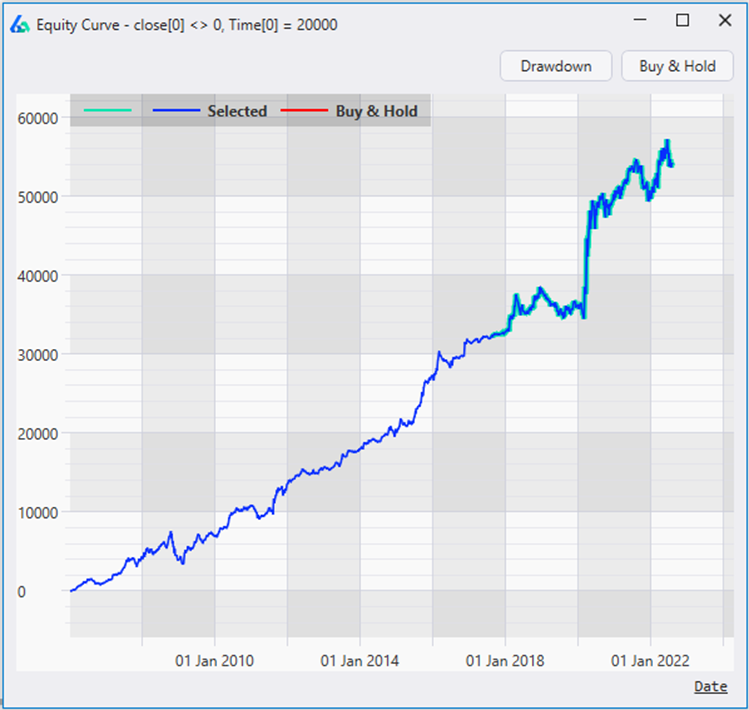
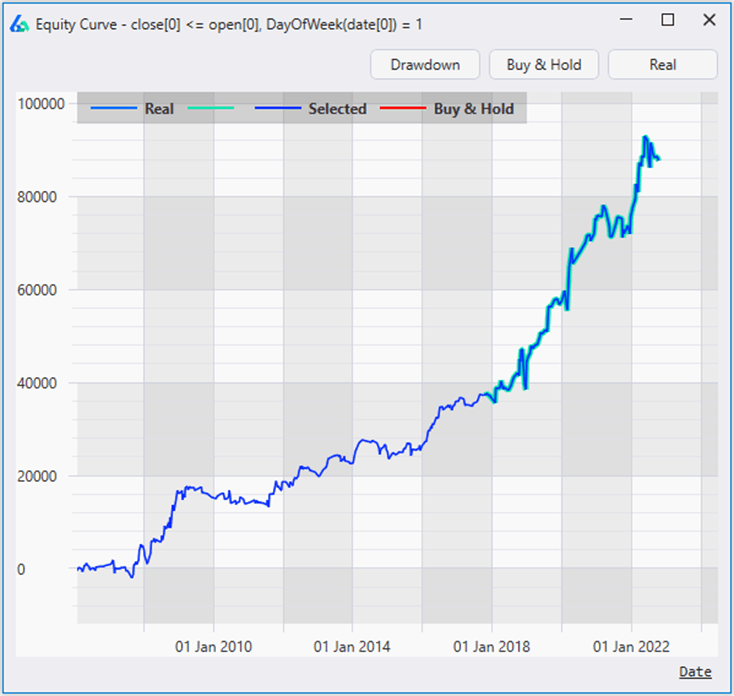
Another strategy I published in 2017 or 2018 that continues to perform well is Turnaround Tuesday strategy. This strategy buys S&P500 futures after a down Monday and holds for one day. This strategy has produced stellar returns looking at the historical data. Here is the original post: Turnaround Tuesday: Wall Street Cliche Or Trading Edge? – See It Market
Testing S&P 500 Futures in Build Alpha (video)
Build Alpha is a no code strategy builder that can enable traders to build, create, and test automated trading systems with no programming. The video below shows how easily you can set up S&P 500 futures and have Build Alpha return the best trading systems based on your inputs.